
Veterinary Hospital
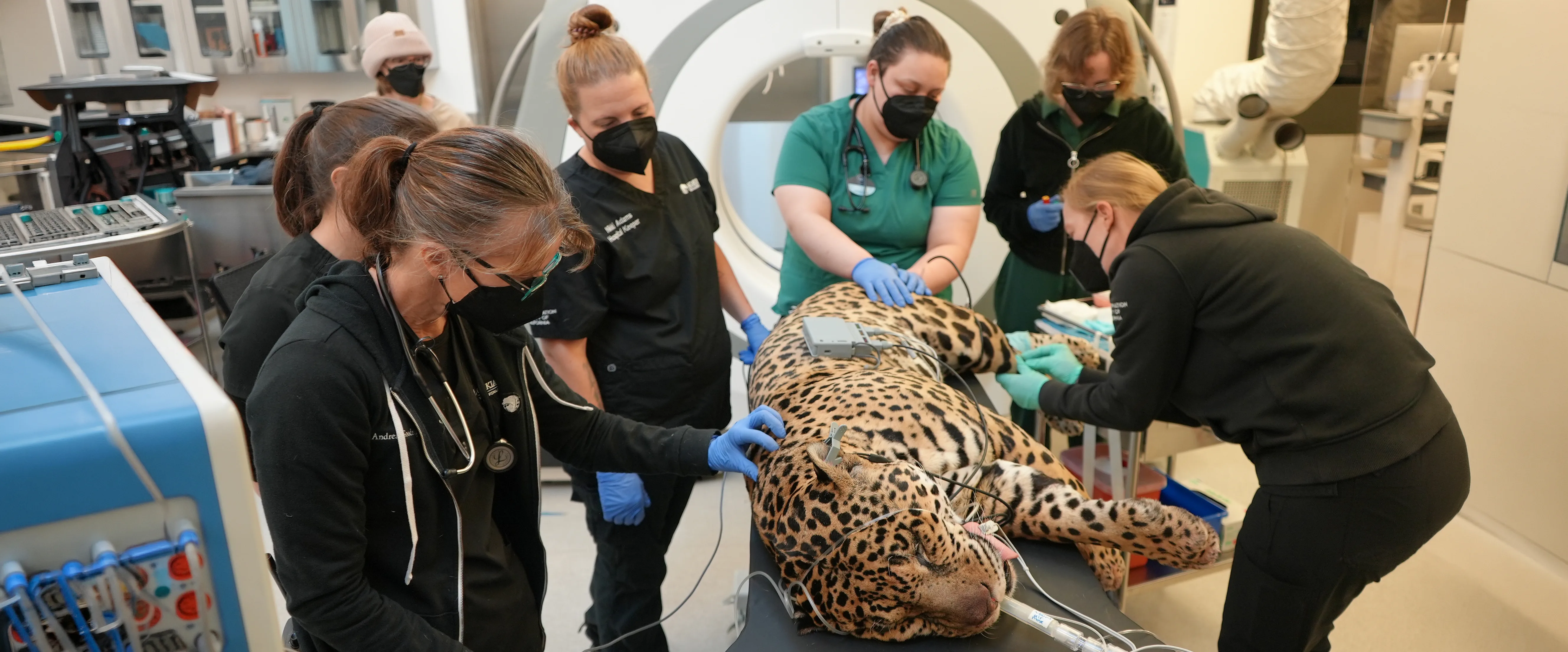
The Oakland Zoo’s state-of-the-art, 17,000 square-foot veterinary hospital was designed to accommodate all current and future animals at the Zoo as well as visiting rescues, from small birds to large tigers and grizzly bears. It features a large procedure room, radiology and surgical suites, a laboratory, a pharmacy, quarantine and hospitalization wards for animals, a full necropsy suite, staff office space, and is LEED Gold certified.
Take your next Zoo visit to a whole new level with a tour of our amazing veterinary hospital.

Animal Care
Animal Comfort
The animal care wing was created with the care and comfort of the Zoo’s animals in mind and is situated in the quietest point in the building to allow animals to adapt to their new home or recuperate without additional environmental stress. This wing holds animals hospitalized for treatment or rehabilitation, and animals in quarantine entering the zoo collection. It features:
- An aquatic stall with a pool for animals such as otters and ducks
- A covered and heated aviary with flying space for small birds
- A climate-controlled room for reptiles
- A climate-controlled room for mammals
- Hoofstock holding that can double as large bird or bird flock holding
- Primate and carnivore holding space
- Both indoor and outdoor access for most stalls
Medical Care
The veterinary hospital is well-equipped to facilitate gold-standard care of the zoo and rescue animals at Oakland Zoo.
Diagnostic equipment includes:
- BodyTOM CT which facilitates 3d radiographic assessment of patients
- Digital radiographs, both built-in and mobile facilitate excellent imaging both in and out of the hospital
- Dental radiographs provide better assessment of dental issues
- An ultrasound allows for detailed soft tissue organ assessment and sampling
- In-house patient point-of-care analyzers provide rapid real-time assessments of patients both in and out of the hospital
- In-house chemistry analyzer allows for full chemistries in under 20 minutes
- A full necropsy suite for postmortem evaluations and sampling
Additional medical equipment includes:
- Flexible and rigid endoscopy equipment
- A full surgical suite and full array of instruments, suction, and cautery unit
- Both ethylene oxide and steam sterilization units
- Remoted drug delivery equipment
- Anesthetic machines and ventilators covering the full range of patient sizes, from tiny birds to giraffes
- A dental machine to provide ultrasonic scaling and high-speed dental drills
Education Opportunities
Veterinary Students
Currently, our only veterinary opportunity outside of hospital tours is an externship designed for veterinary students in their clinical year. Please see the externship description and application process on the American Association of Zoo Veterinarians website under educational opportunities. We do not offer veterinary volunteer opportunities for non-veterinary students at this time.
Tours
Take your next Zoo visit to a whole new level by touring our hospital. The hospital is designed with wide hallways and large, low windows offering views into treatment rooms, which accommodates the variety of guests touring the facility.
For more information and to reserve your tour: Register for a Hospital Tour
Wildlife Partnerships
Thanks to the scope of the Hospital, the Zoo is able to deepen its relationships and become a regional resource in the care of animals associated with our wildlife partners. Common wildlife patients include California condors, pumas, and animals rescued from the illegal wildlife trade.
Environmentally Friendly Design
The Veterinary Hospital is a green facility, and has been certified LEED Gold. The hospital’s design features extensive daylight from sky lights reducing the need for artificial lighting, and a 50-kilowatt roof-mounted solar system comprised of 154 solar panels (donated by SunPower Corporation). Architects incorporated recycled content including fly ash and steel, as well as renewable materials such as FSC wood, icynene insulation (castor oil), and bamboo throughout the facility. There is in-slab radiant heating for the animals, an electric vehicle charging station, and water runoff goes into bioswale for treatment. Even the courtyard pavers are water-permeable.
Important to the facility’s design was the inclusion of over 70 plants and 115 trees representing the countries of origin for our current animal collection as well as 15 species of grasses and plants native to California and the animals we look forward to exhibiting in the planned California Trail expansion.
Special Thanks
Foundations and Corporations
Wayne and Gladys Valley Foundation
Lakeside Foundation
DMARLOU Foundation
S.D. Bechtel, Jr. Foundation
Thelma Doelger Trust for Animals
HEDCO Foundation
SunPower Corporation
Koret Foundation
Thomas J. Long Foundation
The Clorox Company Foundation
Abaxis
Fremont Bank Foundation
Individuals
Warren and Mary Brown
Neil, Diane, and Brian Goodhue
Linda Hart Huber
Eleanor B. Moore
Oakland Zoo Docents
Joel Parrott, DVM and Laura Becker, DVM
Reid and Amy Settlemier
George and Lorri Zimmer