Oakland Zoo Welcomes New Female Tiger, As Part of a Big Cat Transfer, Continuing Decades-Long Commitment to Big Cat Rescue and Care
Oakland Zoo’s decades-long commitment to rescuing and caring for exploited big cats continues with the arrival and placement of five tigers, part of an ongoing effort to provide expert care, rehabilitation, and a permanent home for animals impacted by private ownership and commercial wildlife trade. Oakland Zoo has successfully transferred these tigers after a private owner reached out to the Zoo for assistance in finding suitable placement, following their abandonment at his facility. The effort, in partnership with People for the Ethical Treatment of Animals (PETA), to help these tigers began over a decade ago, tied to the closure of a private roadside facility known for mistreating and neglecting its animals.
Oakland Zoo’s rescue program extends far beyond any single case, and for over 30 years the Zoo has played a unique role among accredited institutions. The Zoo regularly supports law enforcement and animal welfare agencies through case consultation, emergency response, placement coordination, and, when possible, by providing a forever home.
When the Zoo is unable to provide a home, it stabilizes rescued animals and coordinates with a network of accredited facilities to ensure appropriate lifelong care. The recently received tigers illustrate how this system operates, and the extensive expertise needed to assess the best housing options that meet each tiger's needs and wellbeing. Over the past few weeks, the Zoo has worked with partners, including Performing Animal Welfare Society (PAWS) in California and Turpentine Creek Wildlife Refuge in Arkansas, to place three of the tigers and determine the best possible outcome for all those transferred. Both sanctuaries are accredited by the Global Federation of Animal Sanctuaries (GFAS) and are members of the Big Cat Sanctuary Alliance.
Each tiger’s outcome reflects individualized holistic care decisions based on their health, behavior, and long-term welfare:
- A 14-year-old female white tiger, suffering from significant visual impairment due to inbreeding, received intermediate care at Oakland Zoo. Once she was physically prepared, she relocated to Turpentine Creek Wildlife Refuge. White tigers result from a rare genetic mutation called leucism. Breeding these tigers involves pairing two individuals with recessive genes to produce white-coated offspring. However, in these breeding programs, the animals are commonly related, leading to inbreeding that can cause myriad health issues, including blindness.
- A male, white-and-Bengal tiger mix, estimated to be 11 years old, and a male Siberian tiger mix, estimated to be 13 years old, were relocated to PAWS, which specializes in providing expert, lifelong care for older and physically challenged animals with complex needs.
- A female generic tiger, estimated to have been 16 years old, came to Oakland Zoo experiencing end-stage arthritis and spinal disease, causing extreme lameness and neurologic deficits in her hind limbs. She received intensive care at the Zoo’s Veterinary Hospital, but her condition did not respond to treatment despite continuous effort from the veterinary and animal care teams; ultimately, the kindest option for this tiger was humane euthanasia.
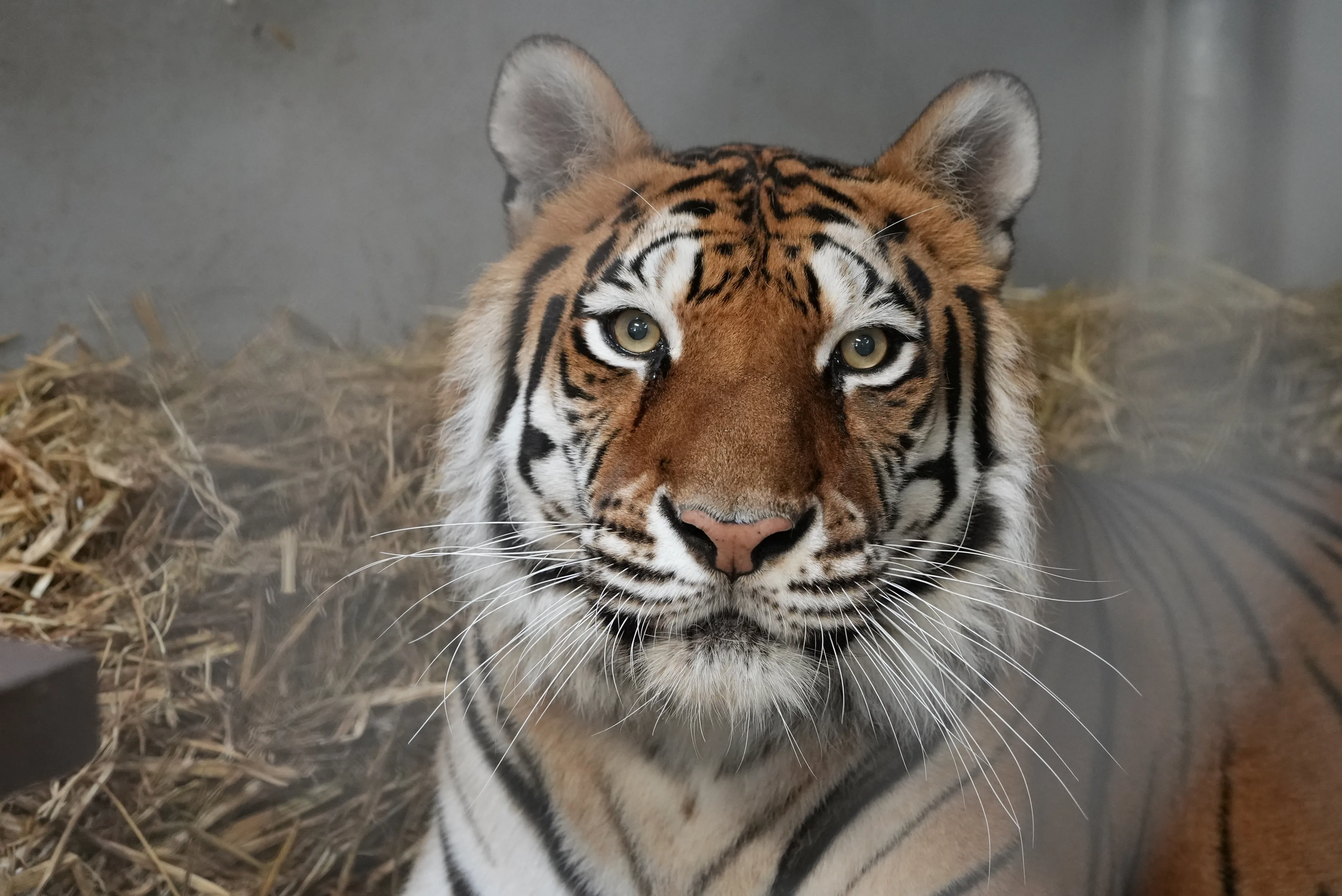
Since the passing of the Zoo’s previous rescued tigers, Mia and Lola, earlier this year, the Zoo has kept a habitat available to provide a home for future tigers in need. With this transfer, a female generic tiger now named Sitara (Hindi origins meaning star), estimated to be 13 years old, has become a permanent resident of Oakland Zoo. Sitara, a female generic tiger, remains strong, though she is experiencing some lameness in her left hind leg. Despite these difficulties, the Zoo’s Animal Care and Veterinary Team is working extensively to settle her in and help her adjust to her new surroundings. She currently has access only to her nighthouse and temporary outdoor space, as she begins to get to know her Animal Care Team and new space.
Sitara will now begin working with her Animal Care staff to train and develop the skills she needs to explore her new habitat. She will learn to navigate pools, a waterfall, raised platforms, grass, and vegetation - all things she hasn’t had before. The Zoo will continue to post updates on social media about her journey. She will undergo a comprehensive medical exam to identify any underlying conditions that are not visible on the surface. Additionally, the Zoo is initiating a program to help her build trust and resilience in response to negative experiences with past caretakers, while monitoring her behavioral and mental health challenges.
“Projects like this remind us that animal welfare is profoundly personal, and one of the most meaningful things we can do is change the life of one individual. These tigers have been given a future with greater stability, greater opportunity, and greater peace. That didn’t happen by chance. It happened because each of you chose to give our skills, compassion, and commitment to something larger than Oakland Zoo,” says Amy Phelps, Zoological Manager at Oakland Zoo.
While these individual stories are significant, they fit within the broader mission and history of Oakland Zoo. The Zoo has cared for numerous big cats, including tigers, for decades, providing a safe refuge and raising awareness among visitors, members, and the community about the challenges posed by private ownership and trafficked wildlife in human care. The arrival of these rescued tigers continues the legacy of more than a dozen Oakland Zoo bigcat rescues and provides an opportunity to share new stories that inspire compassion and support higher standards and regulations for big cats and other captive wildlife nationwide. This latest effort follows over 30 years of the Zoo's dedication to protecting wildlife and to closing facilities involved in the mistreatment, malnutrition, and inadequate care of exotic animals. Oakland Zoo has played a crucial role in rescuing and caring for a wide range of animals, including reptiles, amphibians, mammals, and birds.
Since 2021, the Oakland Zoo has received more than 250 requests from wildlife agencies, advocacy groups, and animal rescue organizations for assistance with rescue operations. These efforts aim to support victims of the wildlife pet trade, roadside zoos, and other forms of trafficking. The Zoo's commitment to rescues requires significant financial and staff investment, especially due to the unpredictable nature of the health and wellbeing of those individuals we rescue. We estimate that in 2025 Oakland Zoo spent more than $100,000 on rescue work, work that is only possible through philanthropy.
“The current tiger cases are not an isolated effort; they are part of a sustained, mission-driven response to wildlife exploitation and trafficking. Through direct rescue operations, partnerships with accredited zoos and sanctuaries, engagement in wildlife policy, and public education, Oakland Zoo continues to advocate for higher standards of care and stronger protections for captive wildlife,” says Darren Minier, Director of Animal Welfare and Research at Oakland Zoo.
Progress has been made since the passing of the Big Cat Public Safety Act, signed into law in 2022, which has significantly contributed to animal protection efforts. The act has curbed private ownership and commercial breeding of big cats in the U.S. It has decreased "cub petting" operations and prevented new private owners from acquiring these animals, helping to reduce illegal activity and protect exotic wildlife. But even with this act, much remains to be done, and enforcement is the only way to achieve a sustained reduction in these crimes.
Sitara and the other recently transferred tigers serve as reminders that more can be done to protect big cats and to educate visitors and supporters about responsible choices. The core issue in the tiger crisis is the breeding of big cats to supply the cub-petting industry, including pay-to-pose photo opportunities.
Oakland Zoo urges its followers to join in taking action against these businesses by refraining from participating in these activities and from sharing anything on social media that encourages or increases demand for these harmful businesses. Though many of the Zoo’s supporters never plan to participate in one of these photo opportunities with wildlife, the Zoo urges followers not to share photos on social media of others playing with young cubs, which encourages others to do the same and perpetuates this harmful business. Social media has become a main driving force for the pet trade, and by acting to reduce the facilitation of sharing, promoting, and monetization of these businesses, demand for these businesses can be mitigated.
For more information, please go to: oaklandzoo.org/endthetrade