Squirrel Monkey

Least Concern, Near Threatened, or Endangered depending on the species.
Forest
South America
Diurnal
Omnivorous
Tropical Rainforest
Characteristics
These small primates have a body length of 9-14 inches and weigh only 1.3-2.5 pounds. Females tend to be smaller than males. Squirrel monkeys have tails longer than their body, measuring 14-17 inches. They move through the forest by leaping from tree to tree. Their thighs are shorter relative to their lower legs to aid in their jumping force. As they leap, they use their long tail for balance. They also secrete and spread musk, which is distributed throughout their fur and has a few purposes including marking territory, deterring predators, and leaving a trail for others to follow. Unlike many other New World monkeys, squirrel monkeys do not possess a prehensile tail.
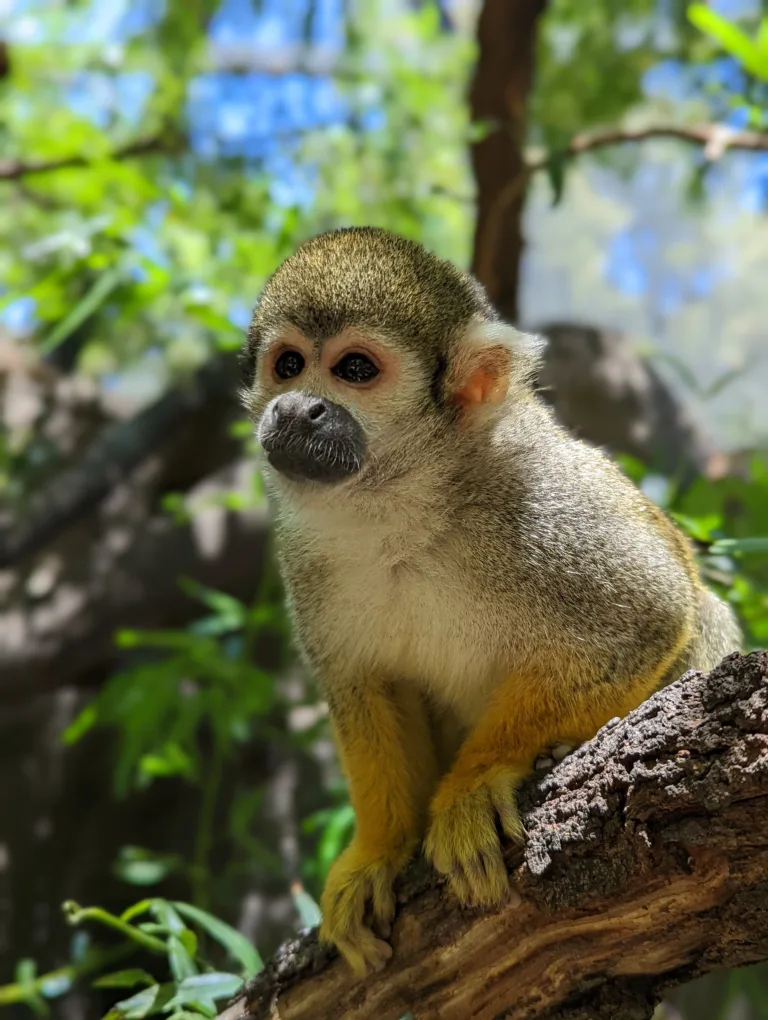
Squirrel monkeys have short, thick, soft fur. The skin on their lips and around their nostrils is black and devoid of hair. The most common coloration is white around the eyes, ears, throat, and on the sides of the neck. The top of their head is black to grayish. The rest of their body has more reddish or yellow fur, particularly on their back, arms, legs, and tail. The tip of their tail is black.
Habitat & Ecology
Squirrel monkeys can be found in Central and South America. They are most common in the Amazon Basin and the surrounding countries like Brazil, Bolivia, Peru, French Guiana, Suriname, Guyana, Venezuela, Colombia, and Ecuador. One species, the black-crowned Central American squirrel monkey, is found in Costa Rica and Panama. Squirrel monkeys inhabit primary and secondary forests, usually along rivers and streams. They use all levels of the forest, but forage and travel mainly on the lower canopy and understory.
Diet
Squirrel monkeys are omnivorous with a preference for fruit. They spend the first hour of the day searching for and collecting fruit, and the rest of the day is spent looking for spiders and insects. In the dry season, when fruit runs scarce, they depend entirely on animal prey. Though they mostly hunt small invertebrates, they sometimes eat bird eggs or young birds when they can find them.
Behavior & Reproduction
Squirrel monkeys can live in groups of anywhere from a dozen to 300 individuals. These groups are predominantly made up of females, but will have multiple males living together as well. Males tend to be more dominant than the females, but there have been differences in hierarchy observed in different regions, even among the same species. Squirrel monkeys are commonly spotted living with capuchins. They are very vocal and communicate with at least 26 different calls. They frequently move in single file, following the same pathways that others have traveled before them.
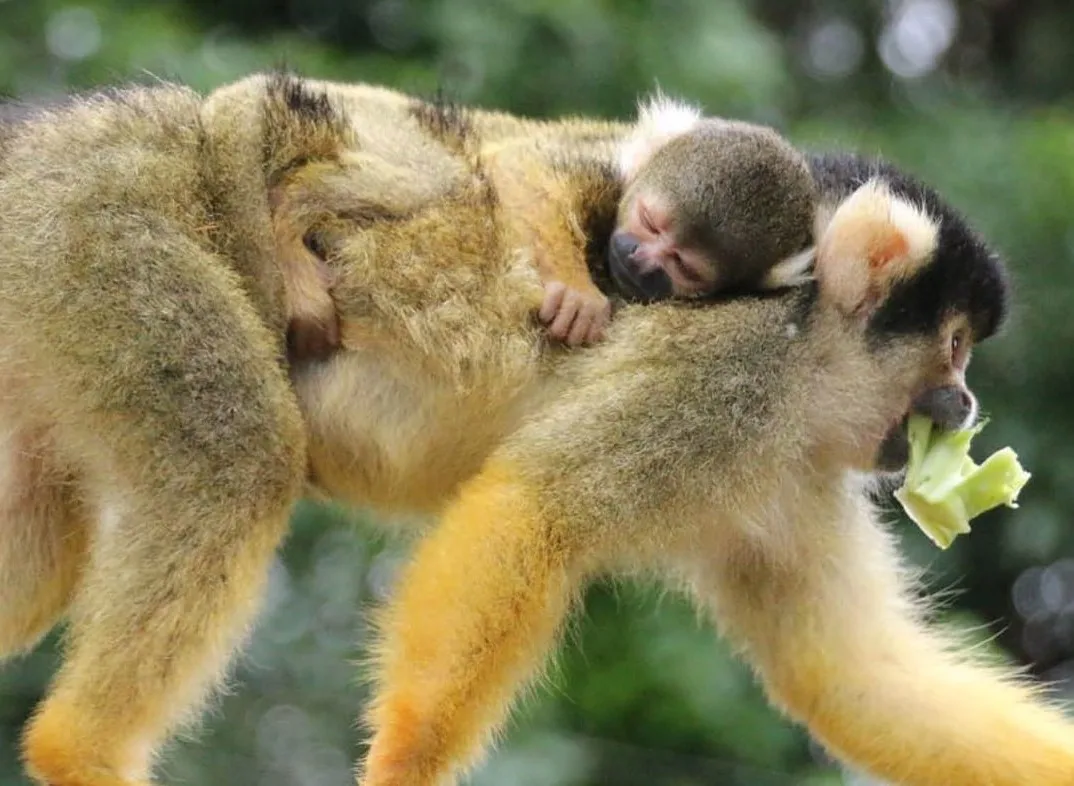
The breeding season lasts from September to November. Both males and females are promiscuous and will mate with several partners. Gestation lasts 5 to 6 months and the breeding season is timed so that babies are born when there is a high abundance of arthropods. Babies stay attached to their mothers, usually by hanging onto their backs, for the first month of their lives.
Wild: 15 years, Protected Care: 20 years
September-November
1
Every Other Year
Conservation
There are several species of squirrel monkey. While most are listed as Least Concern on the IUCN Red List, the golden-backed squirrel monkey is Near Threatened and both the black-crowned Central American and black squirrel monkeys are Endangered. They are facing threats of habitat loss due to deforestation and urban development of natural areas. Squirrel monkeys avoid open areas, so any breaks in the trees for roads present an insurmountable obstacle. Urban development is slowly leading to the fragmentation of squirrel monkey populations.
Additionally, squirrel monkeys have historically been sought after in the illegal wildlife trade. These animals, like all primates, are ill-suited for a life of domesticity. Squirrel monkeys are incredibly intelligent with a high social need. When their needs are inevitably unmet, they become destructive. They also have a habit of urine washing, meaning they urinate on their hands and rub it on their bodies so they can mark their territory wherever they go… definitely not something you want in your own home!
Fascinating Facts
- Squirrel monkeys have the largest brain to body mass ratio of all primates. It is twice the proportion of a human.
- Female squirrel monkeys have a pseudo-penis that they use to display dominance over other, smaller cohorts.
- Squirrel monkeys wipe urine onto their hands and feet to mark their territory. This is called urine washing.
About Our Animals
The Oakland Zoo has a troop of six squirrel monkeys. We have two males, Drew and Pythagoras, and four females, Pele, Piper, Patricia, and Peepers. Drew is our oldest and was born in 2007. Patricia is our youngest and was born in 2012. They were all born at the Oakland Zoo, but are the offspring of rescues from a retired research group. Since they are rescues, they are hybrids of a mix of different squirrel monkey species. They are a very cohesive group that resolves disagreements quickly. They are arboreal animals, which means they spend most of their time high up in the trees. If you listen closely, you can probably hear them chirping back and forth to check in with each other and alert about potential dangers.