Red-Tailed Monkey (Schmidt's Guenon)

Least Concern
Forest
Central Africa
Diurnal
Herbivorous
African Savanna
Characteristics
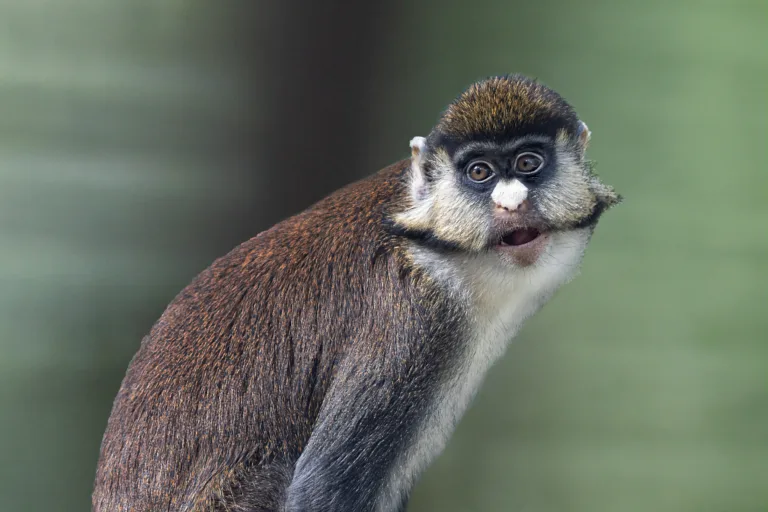
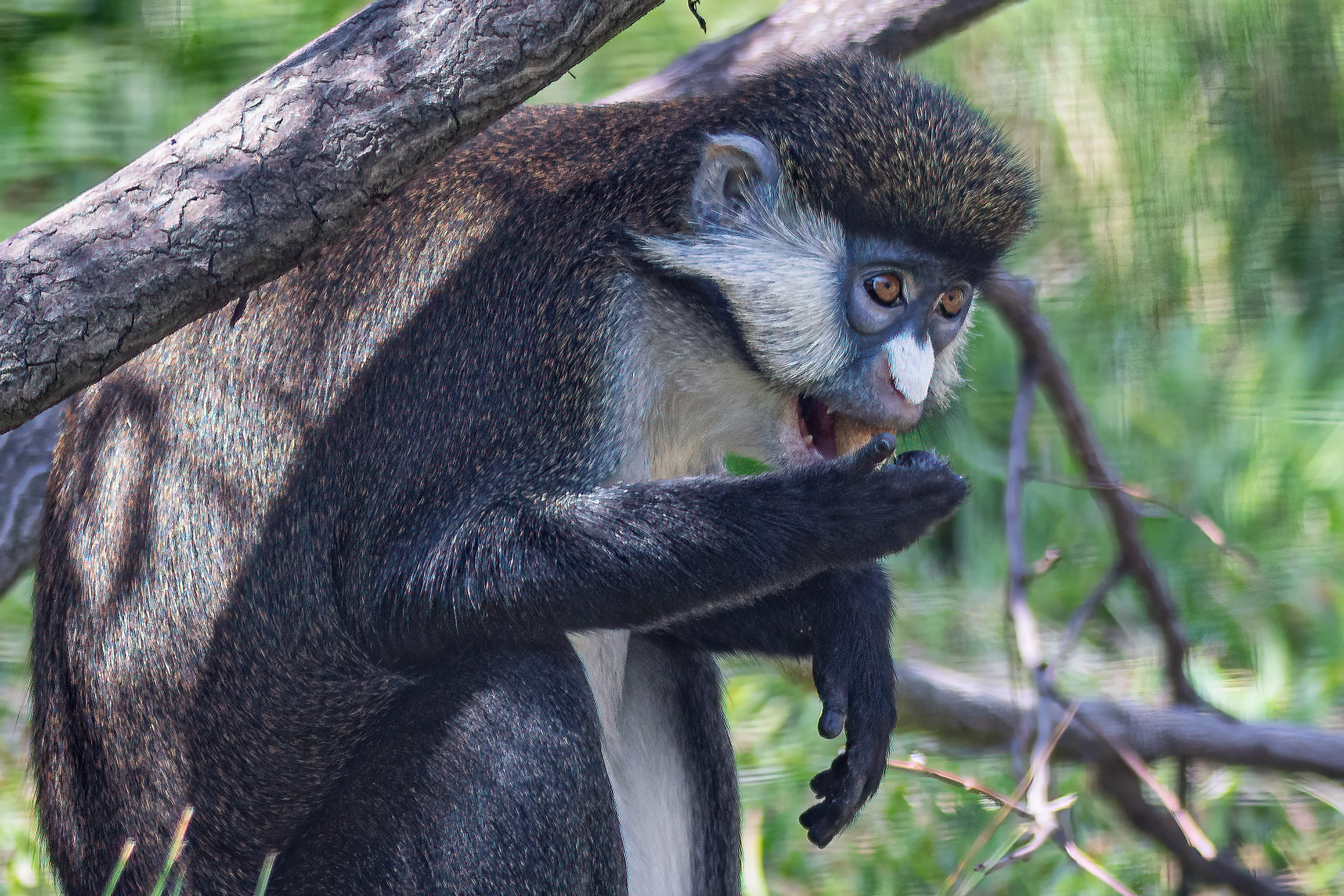
This small monkey is distinguishable by their pronounced cheek pouches that are stuffed with food during foraging. They can fit almost as much food into these pouches as they can in their stomachs. They have a white or yellow nose against a blue-gray face and white cheek tufts.
The red-tailed monkey is named for their long, red tail that measures up to 36 inches (3 feet) which is twice their body length. Males have slightly longer tails than females. The hair on their body varies between speckled brown and gray. Their chest is white, and some individuals have black limbs. Females weigh an average of 4-5 pounds, and males weigh an average of 8-10 pounds. They are known by many names, referred to as Schmidt’s Guenon, Schmidt’s red-tailed monkey, black-cheeked white-nosed monkey, and red-tailed guenon.
Habitat & Ecology
The red-tailed monkey lives in Central Africa. Their range spans parts of Democratic Republic of Congo, eastwards through Kenya and down through Tanzania into Angola and Zambia. Uganda is said to have the highest population density.
This monkey species prefers middle canopy, but has been observed in woodlands such as tropical, swamp, and mountain forests.

Diet
These herbivorous monkeys specialize in eating fruit, meaning they are frugivorous. When fruits are not available, they also eat leaves, flowers, insects and gum or sap from trees. Red-tailed monkeys utilize their cheek pouches to be able to eat in protected areas. After stuffing their cheeks full, adults have been observed taking their meals to secluded areas where they can eat without worrying about other monkeys stealing from them.
Behavior & Reproduction
Red-Tailed Monkeys are active and agile, spending most of their time high up in the trees. They are most active in the early morning and late evening when they forage. Groups are composed of a hierarchical, single male-dominant group with multi-female members. Females also maintain their own dominance hierarchy. Family groups can range in size from 10-30 individuals. Different groups may even join together when foraging for additional protection. Red-tailed monkeys have been observed interacting with other species including but not limited to blue monkeys and red colobus monkeys. These interactions include playing, grooming, and even helping defend themselves from predators.
Red-tailed monkeys breed throughout the entire year. Peak breeding season is from November to February. Gestation for these monkeys is five to six months, and they tend to give birth to a single baby. As with other guenon species, females are the primary caregivers, though other females in the group may assist. Females reach sexual maturity at 5 years old. Typically, the dominant male mates with all mature females in his harem. Juvenile males leave their family groups at around 6 years old and sometimes form groups with other bachelor juvenile males. During this time, the bachelor males will secretly mate with females in families while they rove from territory to territory.
Wild: 25+ years, Protected Care: 28-30 years
All year, peak is November-February
1
estimated 1 year
Conservation
Schmidt's Guenon is listed as Least Concern by the IUCN and on Appendix II by CITES.
The species exists in a wide variety of habitats and is able to withstand hunting pressure from humans. The species population is declining, but it is only threatened on smaller scales, such as isolated forest patches and communities. The rapidly growing human population in some parts of the range has led to habitat destruction related to farming, timber and fuelwood extraction, dam, road and powerline construction, mining, exotic tree plantations and human settlements. The IUCN calls for more research on the population estimate of this species due to the difficulty of traversing their habitat, which is often in dense jungles and swamplands.
Fascinating Facts
- Red-tailed monkeys can fit almost as much food in their cheek pouches as they can fit in their stomachs!
- Red-tailed monkeys use facial expressions, just like we do, to communicate. Eyebrow raising, facial skin stretching, and head bobbing are all used to communicate different things.
About Our Animals
The Oakland Zoo is home to a family group of 5 red-tailed monkeys. This family consists of two males, Marley and Tumbili. Marley is identifiable as the largest of the four, while Tumbili, born in 2026, is the smallest currently. When our monkey troop first arrived in 2020, Marley was only 5 years old and was therefore designated the lowest rank on the dominance hierarchy. Now that he is fully mature, he has taken on the role of the dominant male.
Our troop also consists of three females. Our oldest female is Nonami, who was born in 2008 and is our oldest red-tailed monkey. Nonami is the mother of Tumbili, as well as Skittles, Ikea, our other two females. Nonami, Skittles, and Ikea spend a considerable amount of time grooming each other, which is one of the ways that primatologists measure the quality of two individuals’ relationship with each other! Since our three females spend time grooming each other, we know that they are closely bonded.