Reticulated Giraffe
Endangered
Grassland
Africa
Diurnal
Herbivorous
African Savanna
Characteristics
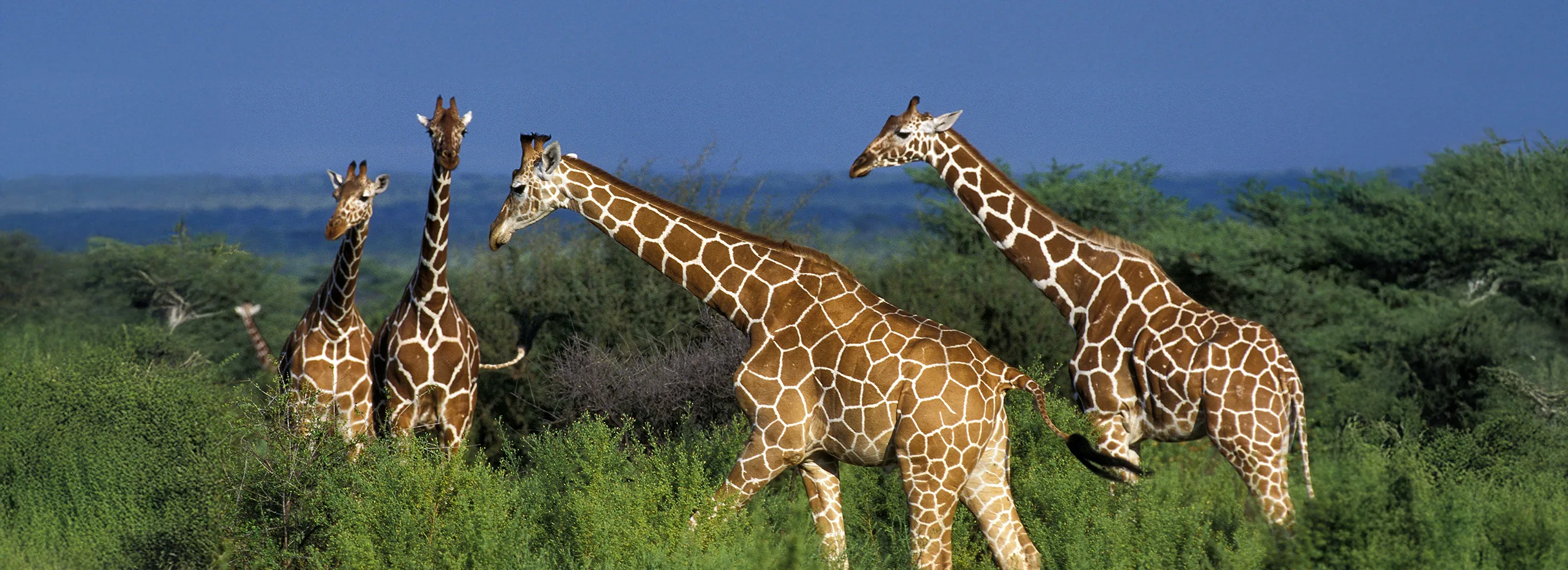
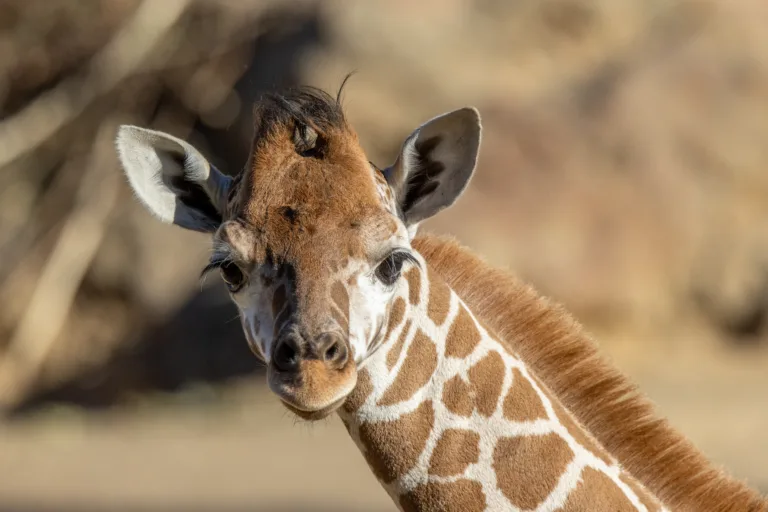
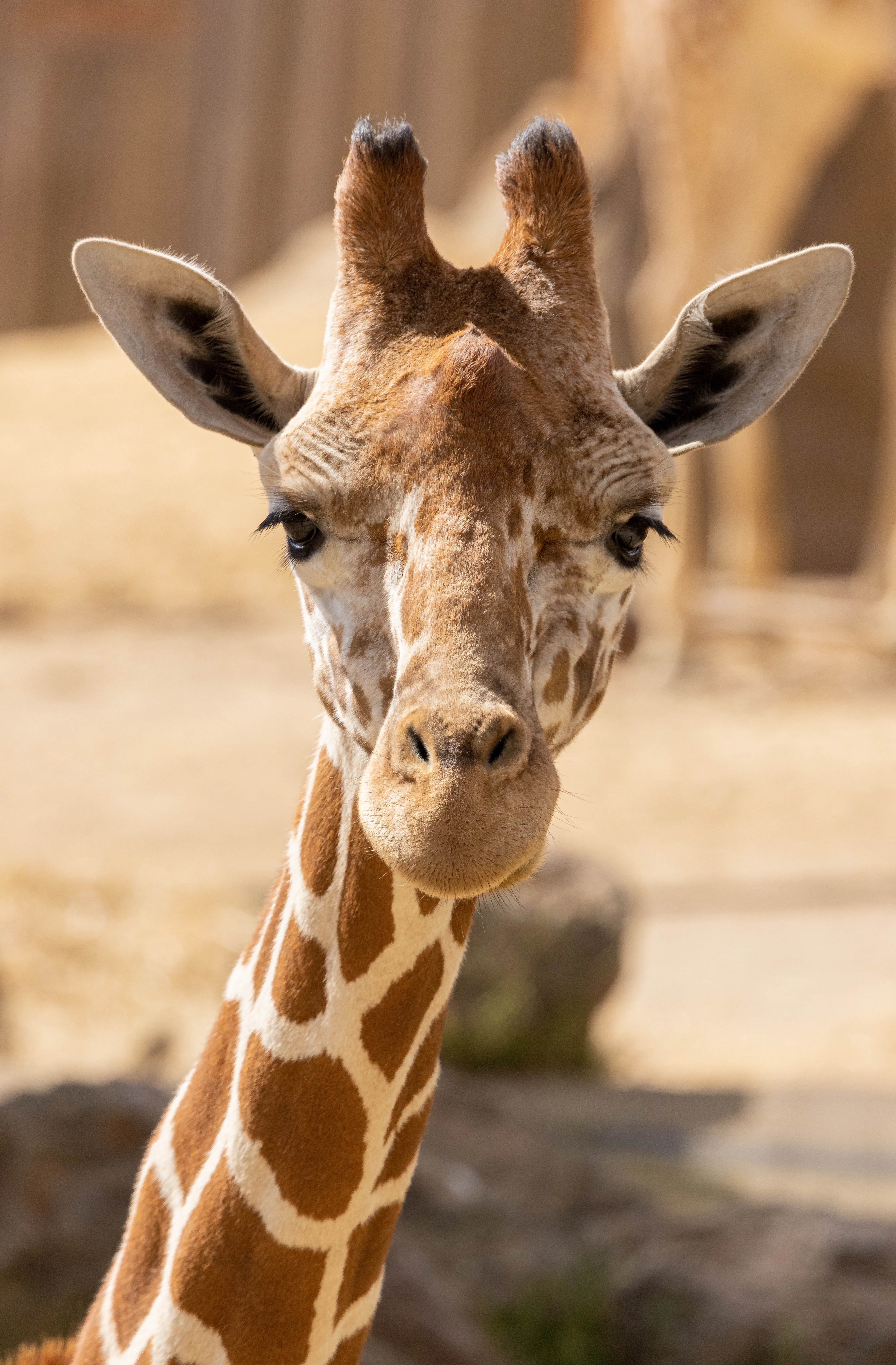
Giraffes are the tallest animals on land. Their long legs and necks allow them to reach heights of over 18 feet. Their back slopes steeply down towards their tail, which is thin and long, ending in a black tuft of hair. The taxonomy of giraffes is hotly debated, but it is generally agreed that there are four species of giraffes, with three of those species further divided into seven subspecies of giraffes. Each is distinguishable by their geographical range and coat pattern. Reticulated giraffes are considered one of the smaller subspecies of giraffe. Males can reach weights close to 3,000 lbs. Reticulated giraffes are covered in irregular dark brown or black polygonal shaped spots that are separated by cream-colored lines that look like a net, giving them the name “reticulated”. Each spotted coat is unique to each individual.
Every giraffe has two notable bony projections at the top of their head covered in fur called ossicones. Males tend to have thicker ossicones because they use them to butt against each other and they calcify more over time.
Habitat & Ecology
Reticulated giraffes can be found in East Africa. The majority of their population lives in north and east Kenya. Smaller parts of their population persist in Ethiopia and Somalia.
Giraffes can be found living in open savannas, grasslands, and woodlands. These giraffes prefer arid and dry land that has an abundance of acacia trees. They are usually found in areas with little to no water, as they seldom need to drink.
Diet
Giraffes are herbivores. They are highly selective on the browse (tree clippings) they feed on, preferring acacia trees and combretum plants. Because the plants they eat have long thorns, giraffes have a specialized tongue to help them eat vegetation. Their long, 18-inch tongue has a wet mucus layer on the bottom and a dry sandpaper texture on top. The rough top of their tongue lets giraffes grip the leaves they want to eat, and the bottom mucus layer allows their tongue to glide over thorns and not get pricked.
Giraffes are ruminants, just like cows and goats, and have a four-chambered stomach. This means that after swallowing their food the first time, they regurgitate it after a while to chew it some more. This process is what allows them to digest complex vegetation with a high cellulose content.
Wild giraffes can go weeks without drinking water because they rely on the dew and water content from their food. When they lower their head to drink from a water source, the specialized valves in their neck constrict the flow of blood to their heads, preventing fainting when they stand up.
Behavior & Reproduction
Giraffes are diurnal. They spend the majority of their day browsing, between 16 and 20 hours per day. They require very little sleep, getting as little as 5-30 minutes in a 24-hour day. In protected care, giraffes have been known to get around 4 hours of sleep per day. They can sleep in quick bouts standing up, around a minute or two at a time. When in the company of other giraffes, they can lay down to rest for a longer period of time while another giraffe keeps watch. Giraffes form scattered herds, the compositions of which are constantly changing.
Bulls are non-territorial and exhibit a dominance hierarchy. Young bulls determine dominance with 'necking displays,' when two giraffes swing their heads at each other’s bodies. Unknown nomadic males may instigate serious fighting with sledgehammer blows being exchanged using the side of the head. When threatened with a predator, they will strike out their forefeet, which can be a lethal kick.
Male giraffes will test fertility in females by checking their urine. This engages their flehmen response, where they lift their upper lip to expose the scent to the vomeronasal organ. The gestation period for a female giraffe is around 15 months. She gives birth standing up, where the calf generally falls 6 feet to the ground. This is an evolutionary response where the newborn needs to have that impact in order to trigger body functions.
10-15 years in the wild, 25 in protected care
May-August
1
1.5-2 years
Conservation
Reticulated giraffes are currently listed as Endangered by the IUCN as of 2018. Their population has decreased over 56% in the last 30 years, with an estimated only 11,000 mature individuals remaining in the wild as of 2017. The reason for their decline is an increase in illegal poaching, along with increased habitat loss.
Fascinating Facts
- Giraffe calves can grow a whole inch every day for the first week after birth.
- For every foot a giraffe is tall, they have an inch of tongue. For instance, a 16 ft giraffe has a 16 in long tongue.
- Giraffes have the largest eyes of any land mammal. Their excellent eyesight makes them the first to spot predators and earns them the nickname “watchtowers of the Serengeti”.
Our Role
The Oakland Zoo supports the Somali Giraffe Project, a trans-boundary community-based conservation project that focuses on the conservation and recovery of the endangered reticulated giraffe through Research, Education, and Community involvement.
You can learn more about what Oakland Zoo is doing for giraffes here.