Domestic Rabbit

Endangered (wild), Not Evaluated (domestic)
Forests and Grasslands (wild)
Europe (wild), Globally (domestic)
Crepuscular
Herbivorous
Children’s Zoo

Characteristics
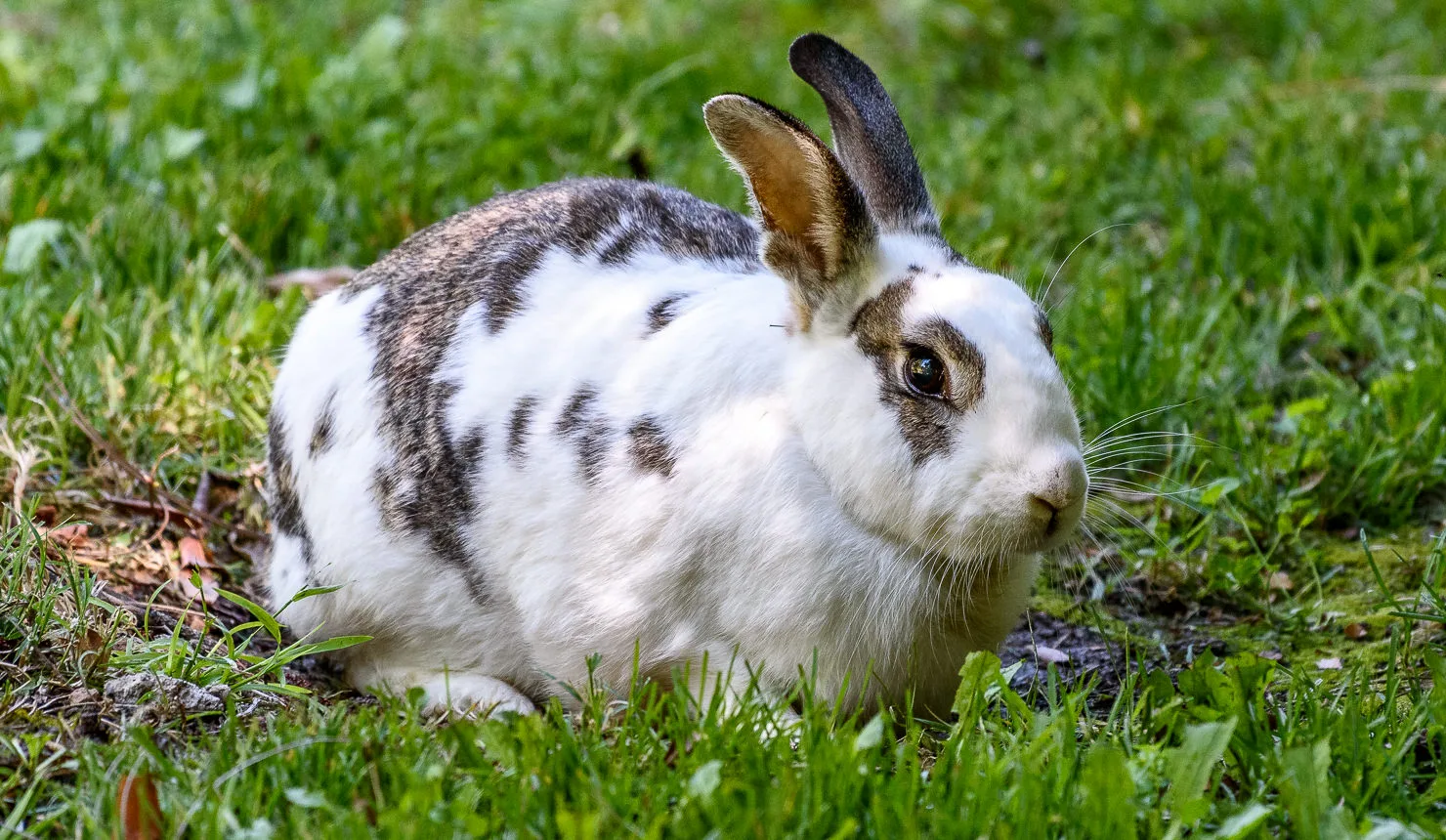
With big eyes, big ears, and huge hind legs to propel them forward, rabbits are an iconic and recognizable animal. However, the domestic rabbits we think of as pets derived from the wild European rabbit, Oryctolagus cuniculus. They are in fact the same species, though domesticated breeds vary in sizes and colors. Wild European rabbits weigh between 3-6 lbs, and can be 15-20 in in length. Their fur is a gray-brown with black speckled throughout their coat. Their underside is a paler gray to white color. Domesticated rabbits can range widely in size; some domestic rabbit breeds are much smaller than their wild counterparts and some are much larger. On average males will be heavier and taller than females. Dwarf breeds of rabbit can weigh around 2lbs and reach 1 ft long and larger breeds can weigh as much as 20 lbs and reach lengths of up to 4 ft. Most domestic rabbits will fall between 2-8 lbs and 1-2 ft in length. Due to selective breeding the coloration of domestic rabbits can vary widely compared to their wild counterparts.
Habitat & Ecology
Wild rabbit species can tolerate a wide range of conditions and therefore can be found in a wide range of habitats, showing preference for biomes with ample vegetation and loose, tillable soil for burrowing. European rabbits, as their name suggests, live almost exclusively in Europe, although introduced populations of the species can be found on other continents. Rabbits can do damage to ecosystems when there aren’t enough predators to control their population, or when introduced or released into places where they do not belong.
Domestic rabbits are entirely dependent on humans to survive, and would not survive if released into the wild. Like all domestic animals, rabbits require specific care to stay healthy and happy.
Diet
Rabbits are strictly herbivores. They will eat hay, grass, vegetables, and fruits, but must make sure that they get plenty of fiber from their diet in order to digest all of the plant matter they eat. Rabbits will also pass and re-ingest specific fecal pellets (poop), called cecotropes, to obtain essential nutrients that were missed during first ingestion. Rabbits use their vision to locate edible grasses and other food, but will then use their sense of smell to determine if it is ripe, or safe to eat. Rabbits are crepuscular (most active during dawn and dusk), and eat constantly during their periods of wakefulness.
Behavior & Reproduction
Both wild and domestic rabbits have complex social and dominance hierarchies, especially during mating season. Domestic rabbits are social and show improved health and wellbeing when they live with at least one other rabbit, though introducing and bonding rabbits together can be a complex and prolonged process. Rabbits rarely vocalize but are capable of grunting, growling or, in cases of extreme stress, even screaming. They rely primarily on body language, including nose and ear movements, body positioning, and thumping their back feet on the ground, and scent marking, rubbing specialized scent glands on their cheeks against objects and spaces, to communicate.
When building a nest a female rabbit will use fur from her chest, called a dewlap, and grasses she collects to provide a safe space for her young. Baby rabbits, called kits, are altricial. This means they rely heavily on parental care to survive. Kits are born hairless and blind, unable to find their own food or flee from predators. As they develop, the mother will visit the nest site only 30 minutes each day to care for the kits - she stays away from the nest for the rest of the day to avoid attracting predators to the vulnerable babies. Kits are weaned by 30 days and sexually mature by 8 months.

1-2 years in the wild, 8-12 in protected care
Jan-June
5-8
1-7 times per year
Conservation
Wild European rabbits are currently listed as endangered by the IUCN. Because of a new strain of Rabbit Hemorrhagic Disease virus (RHDv), it has caused much of the population to decline. Currently, there is no cure for RDHv, but there are vaccines available, although it is difficult to trap and inject wild populations.
Fascinating Facts
- A rabbit’s long ears aren’t just for hearing, but they act as their own personal heater and ac unit! When rabbits are cold, they will bring their ears down to the nape of their neck, where it is really warm. As they pump their blood throughout their body, it warms up, helping them to increase their internal body temperature when the weather is cold. The opposite happens in the heat of the summer! They will stick their ears straight up to cool down in the breeze.
- Rabbits can potty train themselves! Rabbits are naturally very clean animals. In the wild, a specific tunnel in their burrow will be for fecal matter, closing it up and creating a new one once it is full. The same works for domestic rabbits. Placing their pellets into a litter box will help them associate the box with potty time.
- Rabbits have big eyes to help them look out for predators. They have nearly a 360 degree field of vision. Other than a blind spot directly in front of their nose and behind their head, they can see just about everything, even threats from above!
About Our Animals
Oakland Zoo has domestic rabbits varying in breed, size, and color. They came to us as surrenders from a private breeder, and now act as ambassadors for their species; educating guests on the proper care, diet, and space domestic rabbits need.
Our Role
Oakland Zoo actively works on protecting local wildlife. While we do not have wild european rabbits here, we do have riparian brush rabbits, also susceptible to the RDHv. Every year just before breeding season a team of experienced Oakland Zoo staff go out and trap and inject as many riparian brush rabbits with an RDHv vaccine. This helps slow the spread of the virus. Learn more about how we are taking action for rabbits here.