Ornate Uromastyx
Least Concern
Desert, Grassland
Middle East
Diurnal
Herbivorous
Animal Ambassador
Characteristics
Uromastyx are medium-large sized lizards that have wide, flat bodies, a short face, and a stout tail. They are also known as spiny-tailed lizards, dabb lizards, or mastigures. The reason they are known as spiny-tailed lizards is because of the rings of spikey scales they have on their tail. They can have between 10 and 30 of these rings. These spikey tails are used to block the entrances to their burrows.
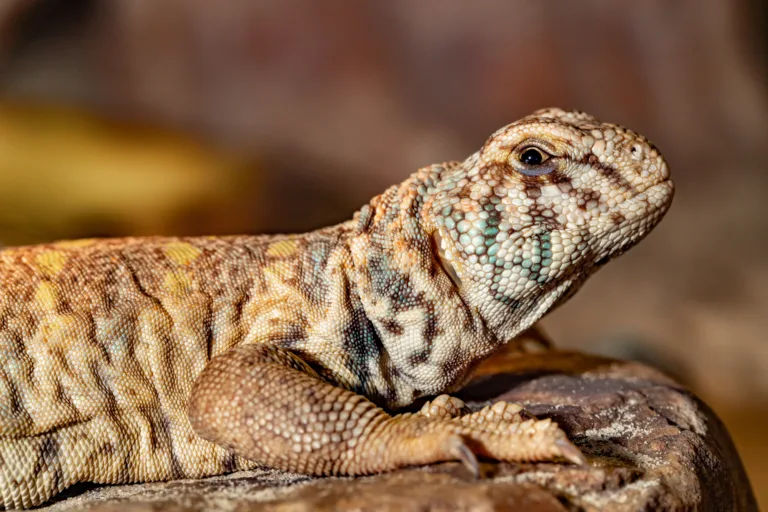
Ornate Uromastyx are a species that can grow up to 14 inches and weigh 300 grams. They have strong legs and sharp claws, which makes them excellent diggers and climbers. They also display sexual dimorphism. Males are among the more colorful of the Uromastyx. Their colors are variable, but their bodies can be green, blue, red, brown, or, more commonly, a mixture of the four. They have irregular red, brown, and yellow markings on their back. Females are duller and colored a light brown or beige with slightly darker brown spots, or even light yellow or red spots.
Habitat & Ecology
Uromastyx lizards are known to inhabit the arid habitats of northern Africa, all the way to India. The ornate Uromastyx is specifically endemic to the Middle East, meaning it cannot be found anywhere else in the world. Their range spans through Egypt, Israel, Saudi Arabia, and Yemen.
Uromastyx are terrestrial and inhabit arid and semi-arid regions such as savanna, shrubland, grassland, deserts, and rocky terrain. They are highly specialized for these habitats and have the ability to reabsorb moisture from their excrement. Their thick tails are also helpful for retaining moisture, as oxidating these fat reserves produces water. These lizards live in crevices or deep burrows for shelter.
Diet
Uromastyx are one of the few entirely herbivorous lizards. ornate Uromastyx usually eat leaves, flowers, and fruit. They particularly like millet! As juveniles, they may eat small insects as well.
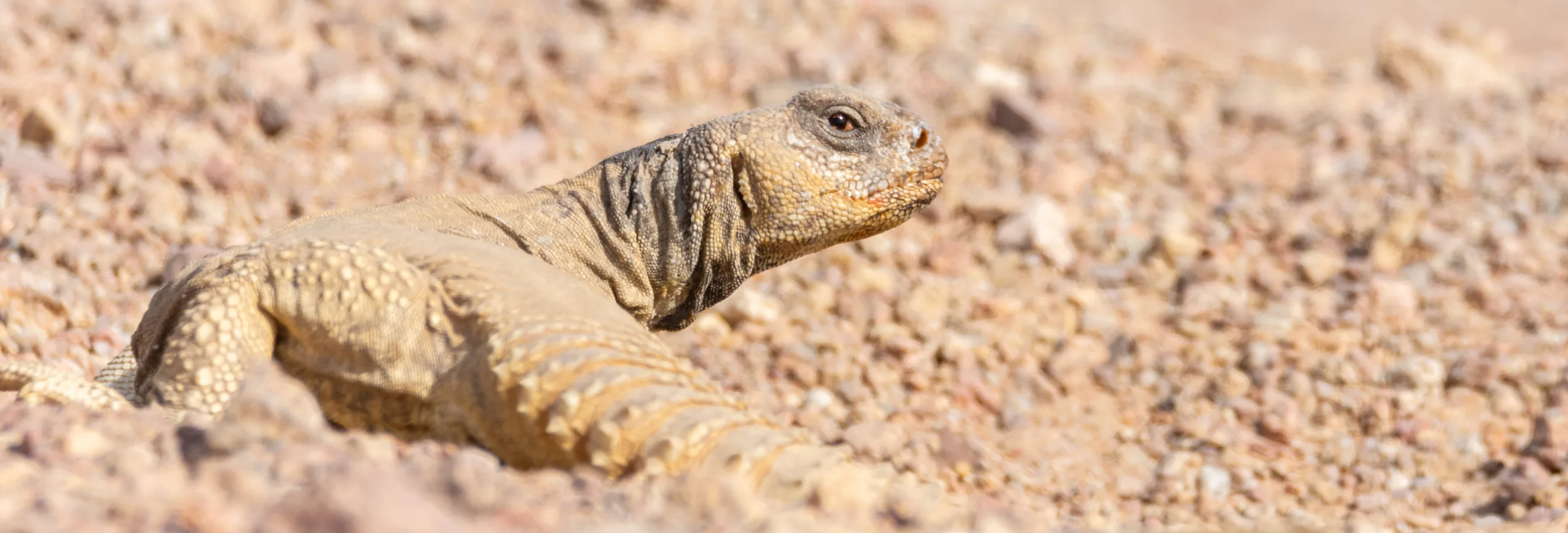
Uromastyx live in areas where plants can have a high salt concentration. In order to extract the salt, they have special glands in their noses that can remove excess sodium. These lizards often have a ring of salt around their nostrils from the expelled salt.
Behavior & Reproduction
Uromastyx are diurnal and solitary. They are most active earlier in the day when they come out to bask in the sun. As reptiles, who are ectothermic, most of their activity level is dictated by their need to regulate body temperature. Uromastyx retreat to their burrows or rock crevices around midday to avoid the heat. These crevices provide a cool, safe spot to hide from any potential predators. Uromastyx are seasonally dependent and will go into brumation, a period of inactivity similar to hibernation, if it gets cold enough. They are most active between the months of March and October when temperatures are 86-118°F.
Ornate Uromastyx begin mating in early spring from March-June as soon as they come out of brumation. Though not particularly social, they are also not very territorial. Males will have overlapping territories with several females they can mate with and may chase away other males. They dig holes to lay their eggs in May-June and eggs hatch in July. These eggs take approximately 70-80 days to hatch and have an average clutch size of 6.67 eggs.
20 years
March-June
6-7
1 year
Conservation
The Ornate Uromastyx is listed as Least Concern on the IUCN Red List but has a declining population. They were last assessed in 2022. Their greatest threats are residential and commercial development, logging, and other human disturbances.
Fascinating Facts
- The largest Uromastyx species, the Egyptian Uromastyx, can get up to nearly 3 feet long!
- These lizards are capable of changing color slightly in relation to their body temperature. When they are warm, their colors become lighter and more vibrant.
- Uromastyx eat food with a high concentration of salt. In order to expel the salt from their bodies, they will snort out salt particles from their noses! Take a look at a Uromastyx nostrils and you will probably see a ring of white salt around them.
About Our Animals
Oakland Zoo has one resident Ornate Uromastyx, Rosemary. Rosemary came to live with us in 2021 after being rehomed from The Living Desert.The way to her heart is a nice bask in the sun. When she is taken out for sun soaking, she quickly relaxes and closes her eyes in enjoyment.
You can meet Rosemary during special Zoomobile, Wildlife Assembly, or ZooCamp programs. During these programs, kids can learn more about these animals and the habitats, adaptations, or other features that make them special. You might also get lucky on your next visit to the zoo and encounter her on a serendipitous Pathway Encounter or Wildlife Theater show.