Common Wallaroo

Least Concern
Grasslands and mountains
Australia
Crepuscular
Herbivorous
Wild Australia
Characteristics
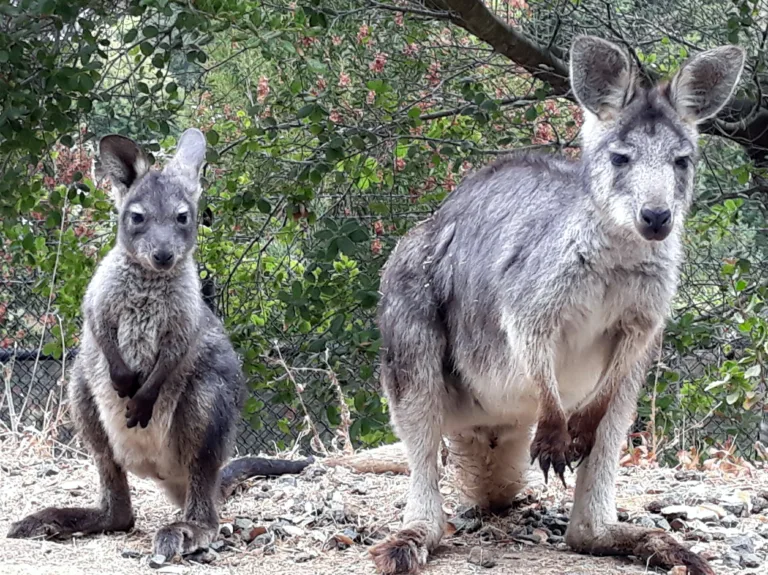
Common wallaroos are medium to large members of the kangaroo family. They have coarse shaggy fur that can range from light brown to a dark blue-black. They are sexually dimorphic, meaning that males and females look visibly different. Males can reach up to 4.5 feet long and weigh 90 pounds, more than twice as much as most females. Wallaroos are largely bipedal, standing on their back legs to survey their surrounds and move quickly, but dropping down to all fours when grazing. With their long feet and powerful legs, they propel themselves forward without the use of their short arms.
Habitat & Ecology
Common Wallaroos are found nearly continent-wide in Australia, except for Tasmania. While they typically prefer rocky hills, overhangs, and caves, they are also known to inhabit shrublands. They especially prefer shrublands near streams and where the shrubs are dense enough to provide shelter. Common Wallaroos play an important role in keeping their ecosystem healthy as seed dispersers. Any seeds eaten that don’t get digested get spread around their habitat in their feces instead!
Diet
Common Wallaroos are herbivores. They graze for most of the day, eating soft-textured grasses and shrubs. They can go 2 weeks without drinking water since they get enough water intake from the food that they eat.
Wallaroos are foregut-fermenters, similar to ruminants, which helps process and break down complex fibers. They have very large incisors on their lower mandible, and 6 smaller incisors on their upper mandible. These incisors are used to grab and tug grasses and shrubs, which are then grinded down with their molars.
Behavior & Reproduction
Common wallaroos are crepuscular, meaning they are active during dawn and dusk. They will rest in the shade during the hottest parts of the day. During the summertime, when it is hot all day long, they will lean more nocturnal to beat the heat. Common wallaroos are typically solitary, but will form loose groups around abundant food sources. Social interaction is usually limited to mothers and their young. They stick to their home range, which can be 2.5 kilometers for males, but only 1 kilometer for females.
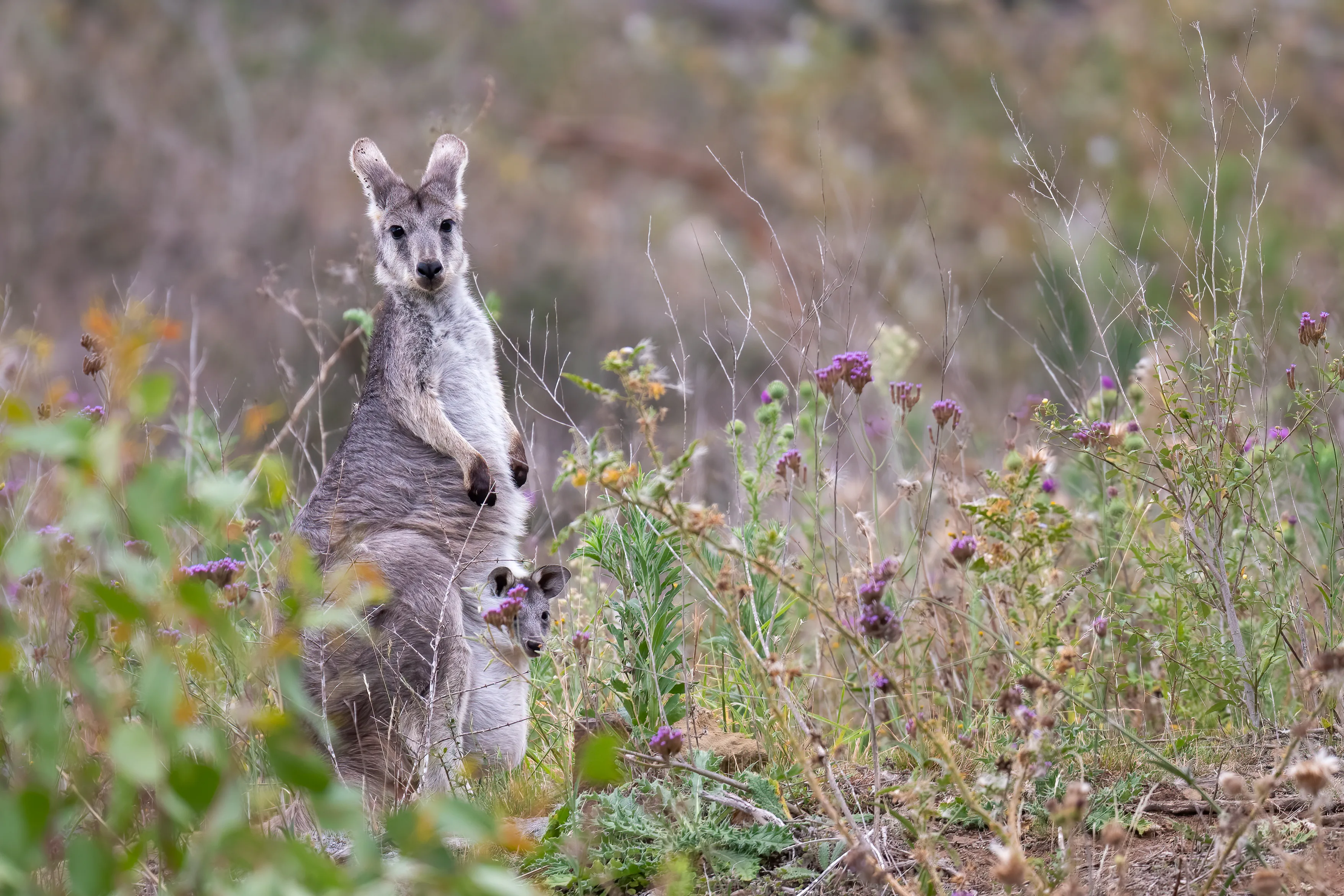
Common wallaroos breed opportunistically year round, and will give birth to one offspring, called a joey, at a time. Male compete over the females by participating in “boxing matches”, in which they primarily use their strong feet to fight each other. Females are usually pregnant for just over a month before giving birth to a jelly bean sized baby. At this point, the joey is not fully developed, but has strong enough arms to crawl into their mothers pouch to finish developing for the next 6 months. After 6 months, the joey starts exploring the outside world, but will continue to return to the pouch to drink milk and rest until 15 to 16 months.

18-24 years
Year round
1
1.5 years
Conservation
Common wallaroos are currently listed as Least Concern by the IUCN due to their wide distribution in Australia. As of their last assessment in 2015, their population is stable, which means there are no signs of decline.
Fascinating Facts
- A group of wallaroos is called a herd or a mob.
- Common wallaroos are sometimes called hill wallaroos because of their adaptations for living in rocky terrain.
- Wallaroos can travel 13 feet in a single jump!
About Our Animals
Oakland Zoo is home to a large mob of roughly 15 common wallaroos that can be visited by riding the train through the Australia section. While a few members of the mob are gregarious, a majority of our wallaroos prefer to stick with one or two other wallaroos in the mob.