Crowned Lemur
Endangered
Forest
Madagascar
Diurnal
Frugivorous
Children’s Zoo

Characteristics
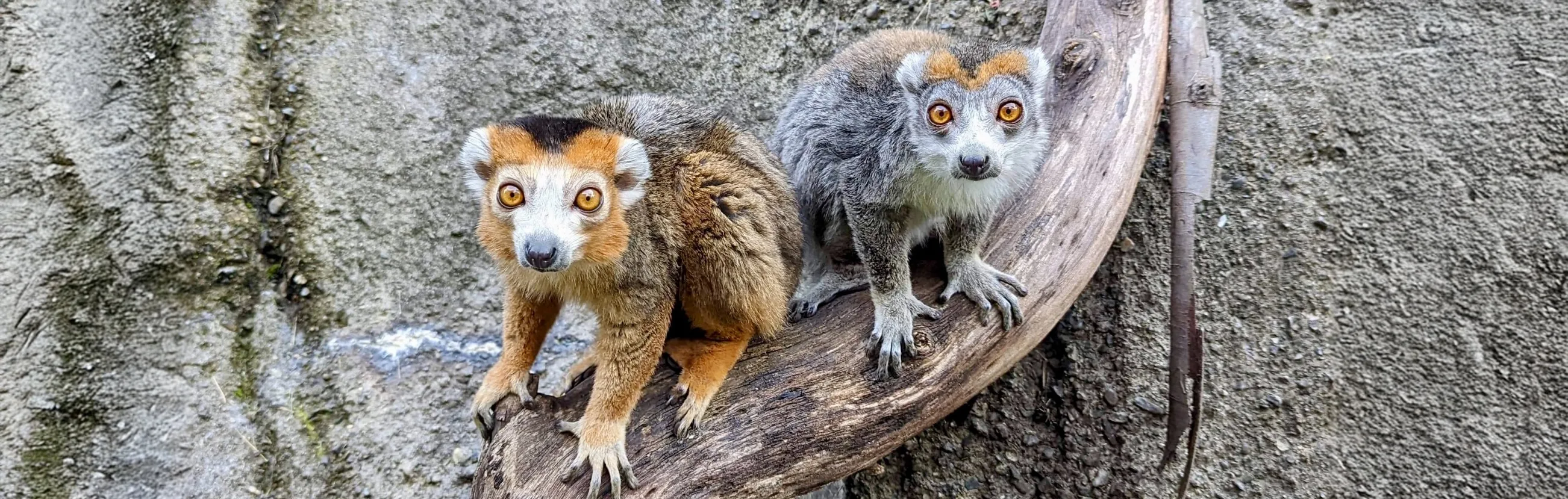
Crowned lemurs are a prosimian, a group of small, leaping primates including bushbabies, tarsiers, lorises, and all species of lemur. Their bodies are around 34cm (13 in) long from the head to the base of the tail, with their long tails measuring at 45 cm (17.5 in). Their tail is not prehensile, but is used for balance and social communication. Crowned lemurs weigh about 2 kg, or just under 5 lbs. While males and females have no noticeable size difference, they are sexually dimorphic. Females are a lighter gray all over their body with a rusty-orange crown at the top of their head and males are nearly the exact opposite - with rust-orange coloring all over their body and light gray and black crown at the top of their head. This difference in color makes them sexually dichromatic.
Habitat & Ecology
Crowned Lemurs are found exclusively on the north side of Madagascar. They live in a variety of forest habitats but show a preference for semi-deciduous lowlands and mid-altitude forests. They can also be found in high altitude tropical forests, wooded savannas, and even agricultural lands. Because of their diet they play a key role in pollination and seed dispersal.

Diet
Crowned lemurs are frugivores and nectivores, meaning they eat primarily fruits and nectar from blooming flowers. The pollen from these flowers sticks to their fur and is transferred to other flowers, pollinating as they move from plant to plant. While they spend most of their time in trees, making them arboreal, they will occasionally pick up fallen fruit off the forest floor. During the wet season, crowned lemurs are also known to eat leaves, and in the dry season they will occasionally feed on insects.
Behavior & Reproduction
Crowned lemurs are social. An average group size for the species includes 5-6 individuals, but can be as large as 15 individuals. They are documented to groom other members of their group to develop and maintain social bonds. Breeding is fluid between the group. Crowned lemurs are polygynous, meaning they will mate with more than one individual during breeding season. Breeding season occurs between May and June, with resulting births between September and October. Female crowned lemurs provide exclusive care for their offspring. Infants will ride on their mothers belly for the first three weeks of their life, then switch over to their back. Offspring are weaned at 5-6 months of age. Crowned lemurs are diurnal, meaning they are generally awake and active from sunrise to sunset.

15-35 in the wild, over 30 in protected care
May-June
1-2
Yearly
Conservation
Crowned Lemurs are currently listed as endangered by the IUCN. It is expected that their population will decrease by 50% over the next 25 years. One of the biggest threats to the crowned lemur population is habitat loss from agriculture.
Fascinating Facts
- Crowned lemurs are the only species of lemur known to forage in the tsingy, an area of jagged limestone rock formations on the island of Madagascar.
- Crowned lemurs have two tongues! A smaller tongue sits below the main tongue and is used exclusively for grooming.
About Our Animals
Oakland Zoo has a troop of two crowned lemurs, living with four ring-tailed lemurs. While these two species would not overlap in the wild, lemur species are gregarious (social) and these two species occupy different levels of the forest. They live here at the Oakland Zoo to act as ambassadors for their species.
Our Role
While lemurs look cute and many people express their want for having them as pets, lemurs are endangered and illegal to keep in most states, including California. They have complex social structures that cannot be replicated in a home environment. Take Action for Wildlife by saying “no” to the illegal pet trade, which has caused many animals, including lemurs, to become endangered.