Hamadryas Baboon

Least Concern
Deserts and Grassland
Northeast Africa
Diurnal
Omnivorous
African Savanna

Characteristics
The Papio genus of "savanna" baboons contains five old-world baboons: Hamadryas, Anubis, Yellow, Chacma, and Guinea. The different species have varying coat colors but a similar build.
The hamadryas baboon is more dramatically sexually dimorphic in size than other old-world monkeys, but they are the smallest of their Papio counterparts.
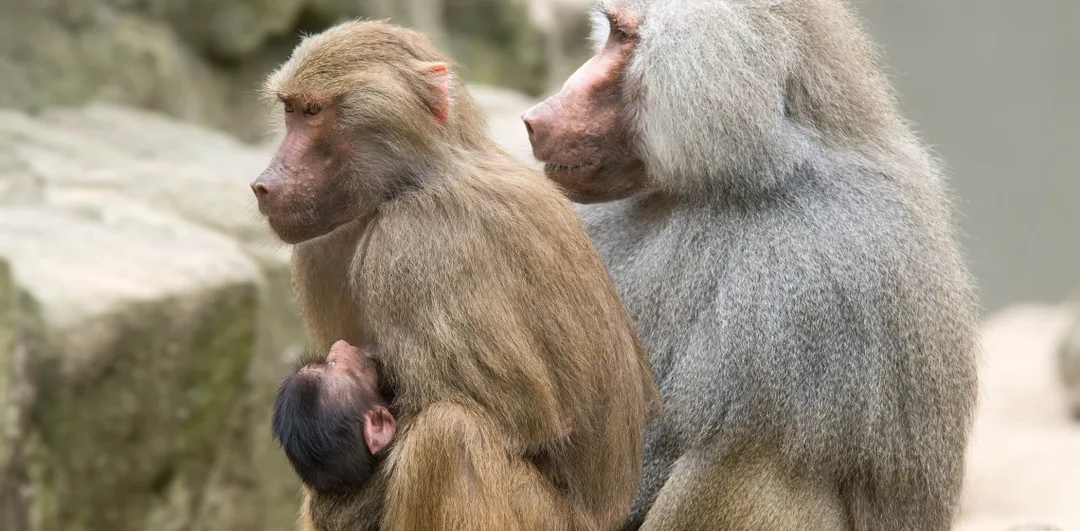
The females grow to about 20-25 inches tall and weigh 20 pounds. The males are typically 24-30 inches tall and weigh around 50 pounds. Males are gray-brown in color with bushy, silvery manes. Females are olive-brown with grayish-brown faces. For both genders, the pelage (fur) is black at birth, and olive-brown at six months of age.
Hamadryas baboons have ischial callosities, or “sitting pads,” that are bright red and pink, which form padding for long periods of sitting and play a role during reproduction. Their tails are long and arched at the base. Baboons' primary sense is their excellent vision. Their eyes are set closely together, giving them good depth perception for spotting predators and seeing other baboons' body language.
Habitat & Ecology
Hamadryas baboons are naturally found in Ethiopia, Somalia, and Eritrea. They have a more northern range in Africa compared to other Papio baboons. While they can be found in a variety of different habitats, they are dependent on sufficient watering holes and cliffs for sleeping. The habitats they can be found in include sub deserts, steppes, alpine grass meadows, and short-grass savannahs.
There are populations in Yemen and Saudi Arabia that are habituated to humans and most likely introduced to those areas by the ancient Egyptian Empire.
Diet
Hamadryas baboons are primarily fruit-eaters, though they also occasionally eat grasses, insects, seeds, and flowers. Most of their day is spent foraging for food. Baboons have a unique ability to survive on a low-quality diet when the habitat cannot provide anything more than grasses, allowing them to use resources from dry terrestrial environments.
Behavior & Reproduction
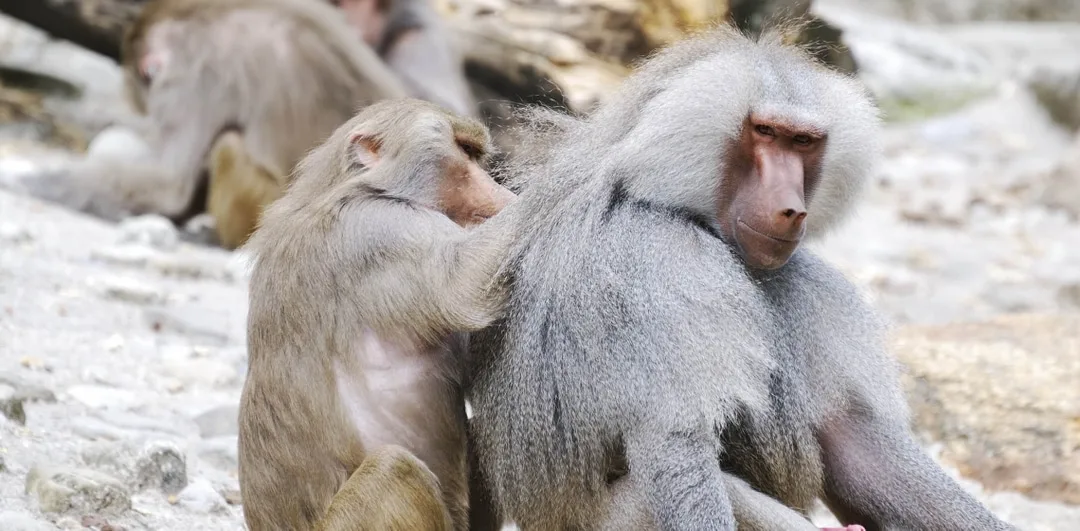
Hamadryas baboons have a unique social structure that sets them apart from the other baboon species. The base of the social structure is made up of One Male Units (OMUs). This is a group comprising one dominant male, one or more females, the female’s dependent offspring, and occasionally “follower” males. To form an initial harem, a male may take a young female from her mother and finish raising her himself. This bonds the pair together very strongly. Females leave their natal groups at around 1.5 to 3.5 years of age and often join groups that contain females they already know to preserve bonds throughout their lives. The females are bonded with the dominant male and strengthen this bond by grooming him. Hamadryas females are unique in that they groom the dominant male more often than other female baboons. This may help them keep their place in the hierarchy and keep him loyal. The act of grooming also releases beta-endorphins which induce a very relaxed state. This can help to ease tensions within the family. Male Hamadryas baboons keep their OMU together by herding the females and biting them on the nape of their necks.
Male baboons, once they have reached sexual maturity and are no longer dependent on their mother, can start their own OMU, become a follower male, or become a solitary male. Follower males are not bonded with any particular female and are not socially at the top of the unit. If a male is not a dominant male of an OMU or a follower male, they are considered solitary males. These males will occasionally interact with OMU’s but are still mostly solitary or can form loose bonds with other solitary males in bands or clans.
Multiple OMU’s can form loose social groups as a band or as a clan. Both types of larger groups are socially strong, often found coordinating travel, foraging and sleeping behaviors. Clans are composed of OMU’s and solitary males in which all the males are relatives, while Bands are groups of OMU’s where the males are not related. The way that dominant males continue to socialize with their male kin throughout their lives with the forming of clans is unique to hamadryas baboons. In other species, males lose contact with their kin after reaching sexual maturity.
Lastly, the largest type of congregation hamadryas baboons often form is a troop. This type of grouping comprises multiple bands or clans and solitary males. Troops mainly serve as protection when sleeping or finding a water source. Troops will also separate with little to no strong social bond.
Females reach sexual maturity around 5 years of age, while males reach sexual maturity at around 7 years of age. At this age, secondary sex characteristics appear in males, including the silver mane, white cheeks, and red/pink buttocks. However, testes become fully developed before these obvious physical traits emerge, which indicates they may be secretly breeding behind the dominant male’s back. Dominant males bite and chase females that copulate with other males, but there is rarely male-male competition within a unit unless part of a dominance challenge.
Wild: 30-40 years, Protected Care: 40 years
Widely Variable
1
1-2 years
Conservation
In the past, huge numbers of hamadryas baboons were taken from the wild for medical research. Today, the hamadryas baboon is listed as "Least Concern" by the IUCN and its population is increasing. This may be due to loss of predators and small-scale agriculture. CITES has this species listed on Appendix II and under the African Convention it is listed as vermin. In ancient times they were present in Egypt, but they are now extinct in that country.
Fascinating Facts
- The hamadryas baboon was sacred in ancient Egypt. They have been found mummified and entombed. They were associated with the sun and the god of learning. They were called sacred, mantled, or Arabian baboons.
- When there is a takeover by a new dominant male, females may go through a "deceptive" sexual cycle. They will appear to be fertile and will mate with the new dominant male. This places them in a high social rank and may protect their current offspring from the new male.
- Different species of the Papio genus have been recorded as being capable of interbreeding with each other. The populations of the hybrid species are often less stable than the original species because of conflicting parental social behaviors.
About Our Animals
Here at the Oakland Zoo, we have one troop of 15 baboons that is split between three groups. Our largest group is an OMU lead by one of our mature males, Kusa. His OMU is made up of six females and three juvenile males. We also have another OMU lead by Milo who has one mature female, Mimi. Our third group is a two male unit comprised of Zachary and Martijn. Zachary, is acting as an apprentice to a much older male, Martijn. He is not the dominant male, but he’s still respected and will lead and teach the younger members of the OMU so his wisdom is not lost. At present we also have a maturing male, Kito who is floating between the bachelor group and Kusa’s OMU as he finds his place within the larger troop.
Baboons have a very fluid social order and their groups are somewhat in a constant state of change. Our keepers have to be very vigilant and keep constant track of these changes to ensure that within our closed system our baboons feel safe and secure while going through these social rearrangements. Sometimes this can mean separating out females who are changing OMU’s or juvenile males as they try and rise ranks in the larger troop.
Our Role
Oakland Zoo participates in the Species Survival Plan for hamadryas baboons. Species Survival Plans (SSPs) are a program managed by the Association of Zoos and Aquariums (AZA). These programs are created to appropriately manage ex situ populations of different wildlife. SSPs are created for specific species by experts in the field who seek to maximize genetic diversity as well as appropriately manage the demographic distribution and long-term sustainability of these ex situ populations. These programs can often be critical for the sustainability of wild populations as well.