Lesser Hedgehog Tenrec

Least Concern
Grassland
Madagascar
Nocturnal
Carnivorous

Characteristics
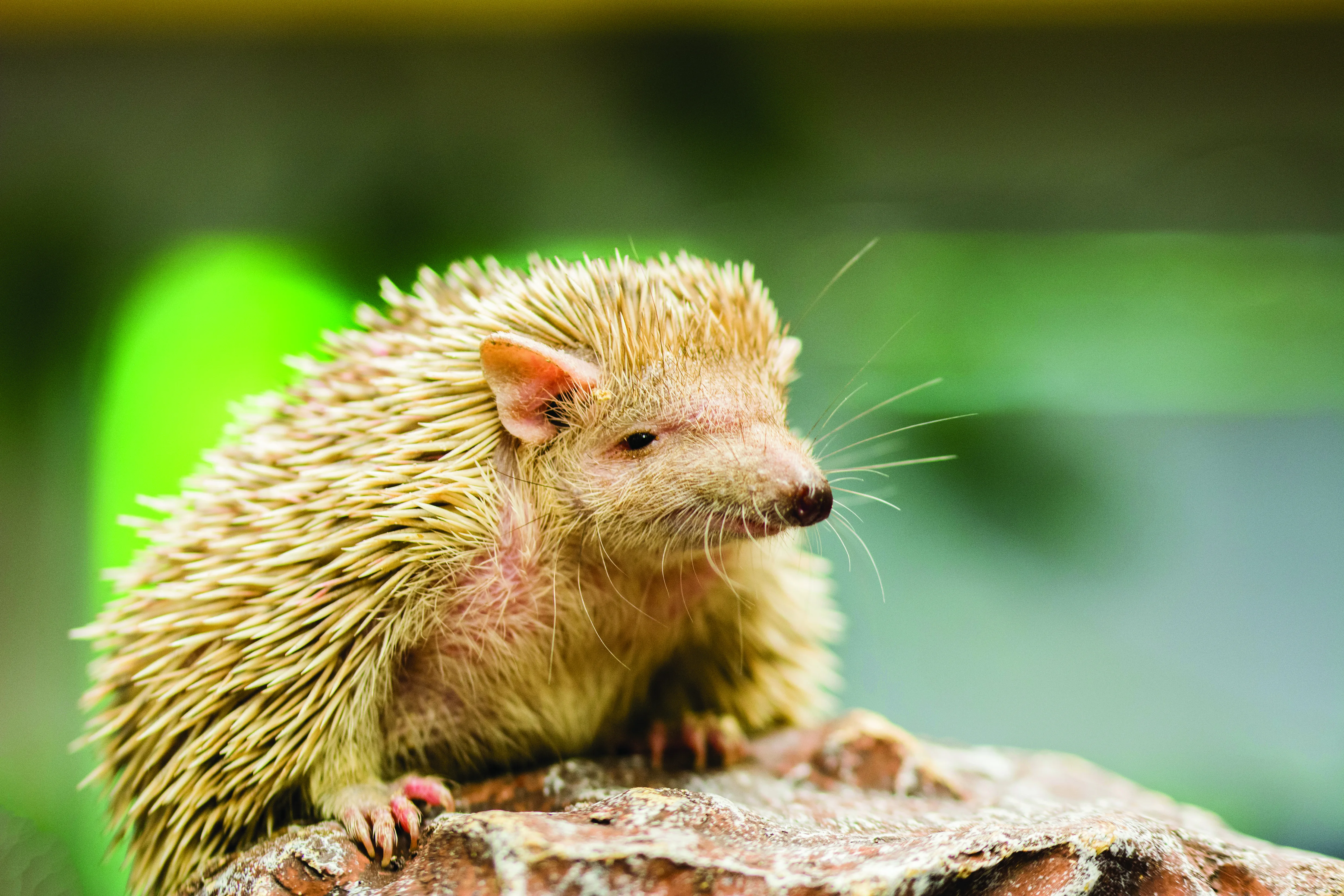
Lesser hedgehog tenrecs are very small, about 7 inches long and 0.25-0.56 pounds, and have stout bodies. They are covered in spines that range in color from a light cream to a darker black. The spines do not extend to the belly, which is merely covered in light colored fur, and they must roll into a ball to protect themselves. Tenrec spines are barbed on the ends and detachable, providing a nasty surprise for unsuspecting predators.
These tenrecs are closely related to shrews and have pointed snouts and sensitive whiskers. Their faces are sparsely covered in fine hair. Their ears stick out and their eyes are relatively small. They have strong grasping toes with tiny, hooked claws. These are helpful for when they climb. They also have very short tails, only about half an inch long.
Habitat & Ecology
This tenrec species is endemic to southwestern Madagascar, meaning this is the only place they can be found in the world. They prefer dry deciduous forest areas as well as xerophytic spiny forests. They can also be found in grassland, shrubland, and farmland.
Diet
Lesser hedgehog tenrecs are considered insectivores, as their diet primarily consists of insects and their larvae. However, they are also known to opportunistically feed on small vertebrates, bird eggs, and occasionally fruit. They have poor vision and instead rely on their excellent sense of smell to find their prey.
Behavior & Reproduction
Tenrecs are nocturnal and often solitary. In the winter, lesser tenrecs experience a period of torpor. Torpor is a state of lowered body temperature and metabolic activity that is not as heavy as hibernation. Despite being mostly solitary, these tenrecs have been spotted together in groups during torpor. This process helps to conserve energy. Torpor can last 3-5 months and takes place during May-October, the Madagascar winter months. Lesser hedgehog tenrecs are semi-arboreal and nest in tree hollows. At night, they emerge from their nests and forage for food.
Tenrec begin mating in the spring as soon as they emerge from their winter torpor. In the southern hemisphere, this takes place in October. Usually, gestation lasts 61 to 68 days. This results in the offspring being born in the wet season, when food is most available. Lesser tenrecs can have litters ranging in size from 1 to 10, though 5 to 7 is most common. Tenrecs are dependent at birth and rely on their mothers for the first month of life. They become sexually mature at 1 year of age, after experiencing their first torpor.
Wild: 8-10 years; Protected Care: 13 years
October
5-7
1 year
Conservation
Lesser hedgehog tenrecs are considered Least Concern on the IUCN Red List. They were last evaluated in 2016 and were found to have a stable population. The ongoing destruction of Madagascar forests is the greatest threat to lesser hedgehog tenrecs.
While they are not listed on CITES, all tenrecs are illegal to own in the state of California.
Fascinating Facts
- Despite what their name implies, lesser hedgehog tenrecs are not real hedgehogs at all! They are in a completely different order than hedgehogs. Hedgehogs and some species of tenrecs have developed similar spikes through convergent evolution and are often confused with each other.
- Millions of years ago, tenrecs were the very first mammals to find their way to Madagascar.
- Tenrecs sometimes use echolocation and clicking sounds to find their way in the dark.
About Our Animals
The Oakland Zoo has one resident tenrec, Kely (pronounced “Kee-lee”) which is Malagasy for “small”. Fittingly, Kely is small enough to fit in the palm of your hand. He was born in 2011 and has lived at the Zoo since 2015. Despite being an old man in tenrec years, Kely has a bright and inquisitive nature (once he finally gets out of bed!). He loves foraging for insects in his dig box and exploring new enrichment that stimulates his nose.
Since Kely is part of our animal ambassador program, he is usually found behind the scenes. You can meet Kely during special Wildlife Assembly or ZooCamp programs. During these programs, kids can learn more about these animals and the habitats, adaptations, or other features that make them special. You might also get lucky on your next visit to the zoo and encounter him on a serendipitous Pathway Encounter or Wildlife Theater show.