Meerkat

Least Concern
Desert and grassland
Southern Africa
Diurnal
Carnivorous
African Savanna
Characteristics
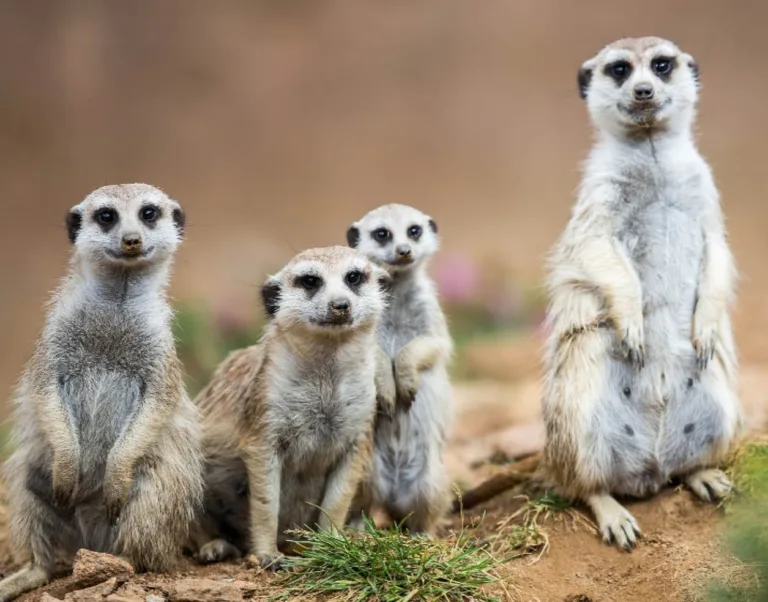
The meerkat, also known as the slender-tailed meerkat, has a long, thin build, 4 toes with long claws on each paw, and small crescent-shaped ears. They're the only members of the mongoose family that don’t have a bushy tail. Their long, soft coat is grizzled gray or tan with buff to yellowish underparts. Their heads are almost white. Meerkats are around 6-7 inches tall, 9-12 inches long, and weigh 1.5-2.5 pounds. Females are slightly larger than males and have six mammae.
Meerkats have long, horizontal pupils that give them a wide range of vision for seeing predators. Additionally, they have a special membrane that can cover their eyes to protect them while burrowing, and ears that close to keep out the sand. The dark patches around their eyes help cut down on the sun's glare.
Habitat & Ecology
The meerkat’s range spans across the western parts of southern Africa. They can be found in Namibia, Botswana, South Africa, and Angola. They live in open, arid savannah, deserts and plains. They prefer to inhabit areas with firm to hard soil. Meerkats are well-equipped to live in areas with fluctuating temperatures because of their fur. Meerkats have thin fur and dark skin on their stomachs that helps them control body temperature. They can lie on their backs and get quickly warmed by the sun or lie stomach down on a cool rock in the heat of midday.

Diet
Meerkats are carnivorous and use their phenomenal sense of smell to locate concealed prey, then dig it out with their long-clawed forefeet. Their pointed snouts are thrust into the narrow trenches they excavate to grasp beetle larvae and the like. They have sharp canines and broad molar teeth with sharp cusps for their insect diet. This diet can also include spiders, snails, rodents, birds, eggs, lizards, and scorpions. They are immune to scorpion venom and some snake venom.
Behavior & Reproduction
Meerkats are social and live in large groups of 10-15 individuals called gangs or mobs. These groups are matriarchal, and females stay with their packs for their entire lives. In the morning, meerkats carefully emerge from their burrow and spend a little time sunbathing, grooming, and playing. Once warmed up and ready to go, the meerkats forage for most of the day before returning to the main burrow to rest for the night. They are ferociously hostile towards other packs.
Meerkat’s communal living is essential for their survival. While foraging, adults take turns serving as a lookout or a sentry. They climb to a high structure, be it a rock, termite mound, or bush, and stand on two legs. They announce the beginning of their lookout shift with a specialized call. If a predator is spotted, the sentry lets out a bark or whistle and the meerkats all dart for the closest hole called the “bolt hole”. These bolt holes are scattered throughout and have slightly wider openings to account for the whole group rushing in at once. Meerkats protect themselves by memorizing the location of the bolt holes, stirring up dust to cover their tracks, or standing together to look larger.
Reproduction is not monopolized by an alpha pair, and each family unit usually has a breeding pair. Gestation is 11 weeks and they breed every two to three months depending on resource availability. Both breeding and non-breeding meerkats share the duty of raising young and teaching them how to hide, hunt, clean, and defend their territory. The mother needs to spend time foraging to supply her pups with milk, so other females and males stay behind to care for and protect her young. The babies are carried around by the scruff of the neck. The pups spend most of their time playing. The average litter size is 3-4 pups, born with eyes and ears closed, and unable to urinate or defecate without stimulation from the mother. Ears open at about 10 days of age, and eyes open at 10-14 days. The young are weaned around 7 to 9 weeks of age.

Wild: 8 years, Protected Care: 13 years
Year-round, but mostly August-March
3-4
2-3 months
Conservation
The slender-tailed meerkat is listed as Least Concern on the IUCN Red List and their population has been stable. However, they have not been evaluated since 2015.
Fascinating Facts
- A meerkat is not a cat, but is instead a member of the mongoose family (Herpestidae). The name meerkat is the general Afrikaans term for mongoose.
- This gregarious species has at least 10 distinct vocalizations including growls, spits, scolding clucks, and a defensive alarm bark.
- Meerkats take their sentinel duties very seriously. When foraging, there is always an adult standing guard, and they mark the beginnings of their shift with a specific call.