Tiger
Endangered
Forest
Asia
Nocturnal
Carnivorous
Tropical Rainforest
Characteristics
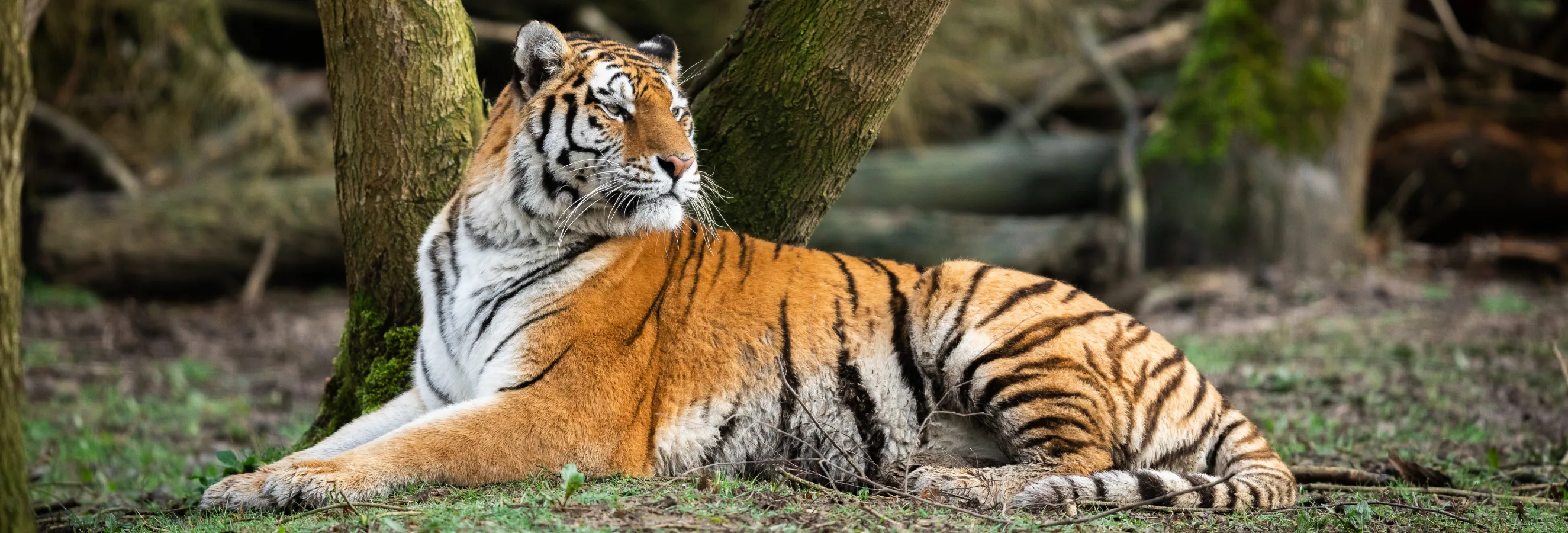
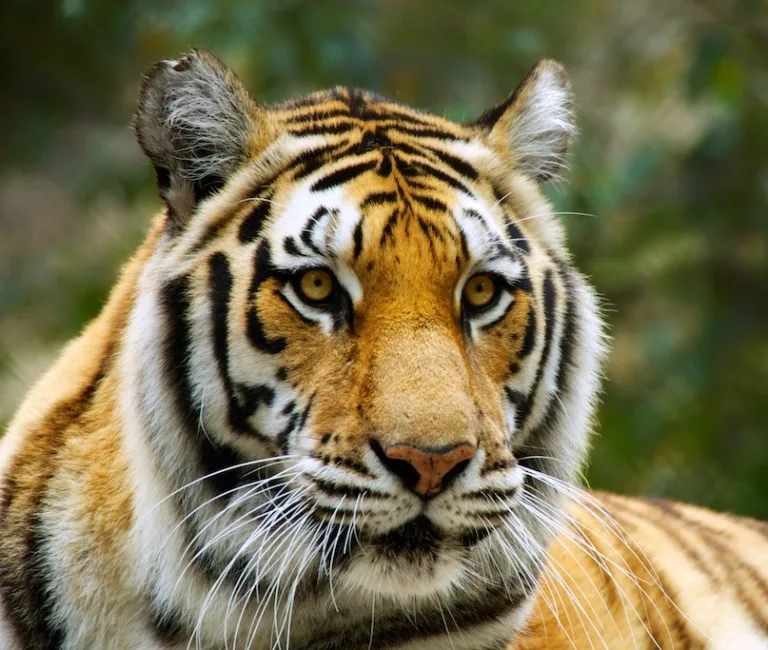
Tigers are well known for their orange and black striped coats and can range from a pale to deep red-orange in color. Their coat is expansive and covers their head, tail, and legs, while their undersides are white. This striping pattern mimics the shadow of the sun filtering in through the treetops and helps to camouflage them better.
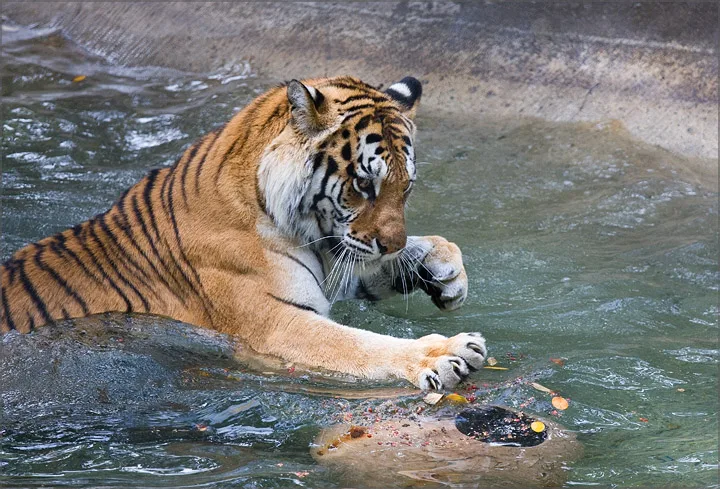
Tigers’ muscular necks, broad shoulders, and powerful forelimbs are perfectly suited for grappling with their prey. They have powerful jaws and a raspy tongue covered in hard papillae (small bumps and ridges), which they use to scrape flesh off their prey. They are excellent swimmers and jumpers, able to jump 25-30 feet at a time. Tigers are the largest of the big cats and some can reach up to 12 feet long and weigh 930 pounds.
There are varying accounts of how many subspecies of tiger there are. Their differences are usually based on region, size, color, and striping pattern. The tigers that live at the Oakland Zoo are considered “generic tigers,” as there is no specific subspecies classification they appear to fit and they are likely hybrids of different subspecies.
Habitat & Ecology
Historically, tigers could be found from Northeast Asia, down to Southeast Asia, and west to the Middle East. They are now extinct in much of this range and many populations exist separate from each other, leading to the rise of separate subspecies in each region. Today, they can be found south of the Himalayas, all the way down to Indonesia. They can also be found in eastern Russia near the coast.
Tigers can live in a wide variety of habitats, from tropical lowland evergreen forest, monsoonal forest, dry thorn forest, scrub oak and birch woodlands, tall grass jungles, to mangrove swamps. They cope well with extreme temperatures and can handle environments that get all the way down to -40° Fahrenheit.
Diet
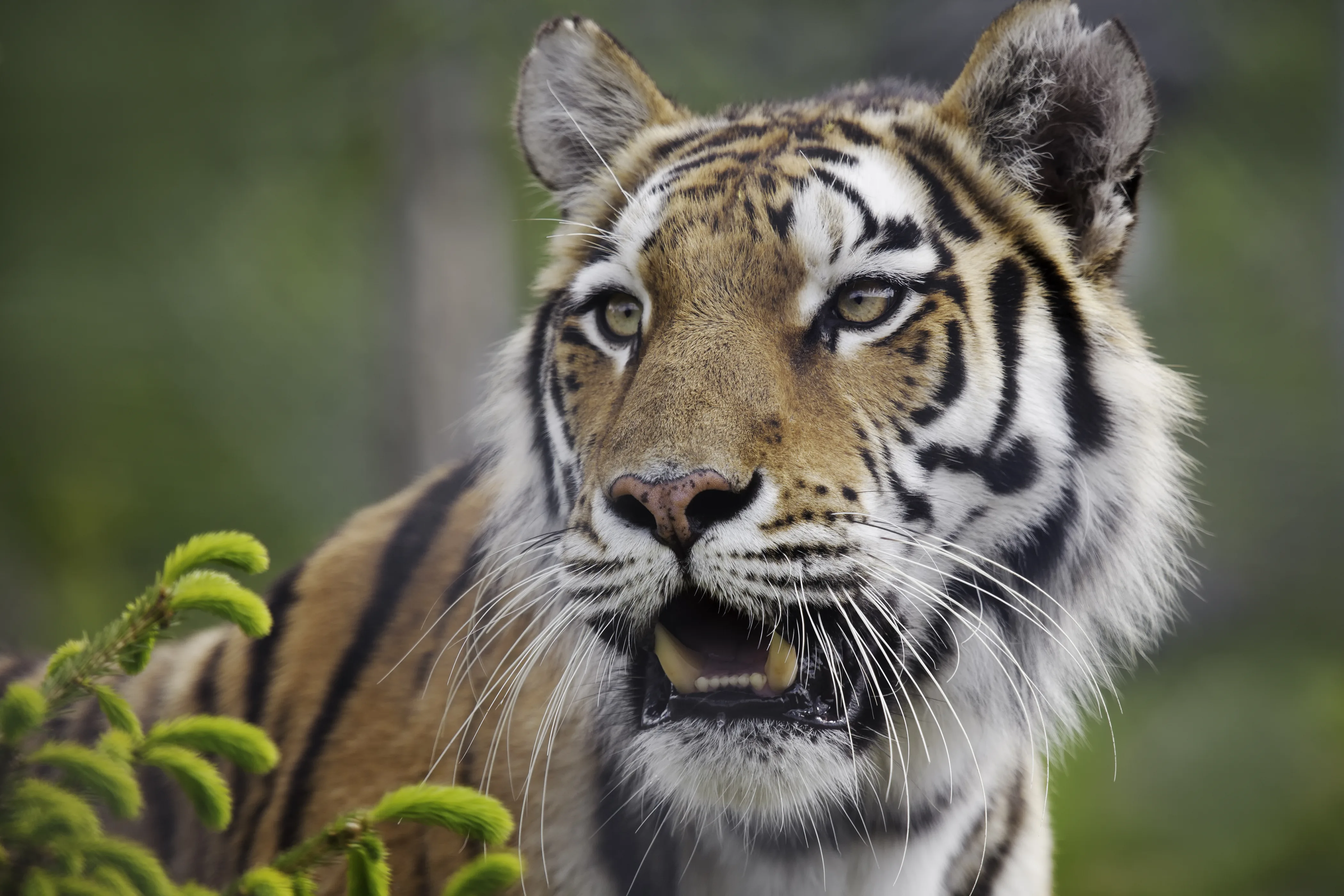
Tigers are considered “true” or obligate carnivores. This means that they are incapable of properly digesting important nutrients from plants and must eat meat to survive. While many animals are carnivorous and thrive on a meat-based diet, only a select few are obligate carnivores. Tigers mainly prey on large ungulates (hooved animals), this includes elk, sika deer, and water buffalo. They will also hunt domestic ungulates such as cattle, horses, and goats.
Tigers are ambush predators and don’t often have to chase their prey very far. When hunting, tigers rely primarily on sight and sound. They stealthily stalk their prey, using rocks, trees, and bushes as cover before pouncing. They are very capable climbers and swimmers, so little can stand in their way. They don’t usually eat all the carcass at once and will drag it to a covered area and revisit over the next several days.
Behavior & Reproduction
Tigers are nighttime hunters, mirroring the schedule of their prey. They ebb between being crepuscular (active as dawn and dusk) versus nocturnal (active at night). This allows them to stalk and capture their prey effectively, as well as evade any human interaction. Tigers will hunt in areas with dense vegetation, as it helps them hide, and they will usually follow paths made by other animals so that they can stay silent when moving. Tigers can travel far distances depending on the density of the prey population, sometimes traveling 10-20 miles in a single night.
Tigers are very solitary, meaning most of their communication occurs via scent markings or vocalizations. Scent markings are sprayed on grass, trees, or rocks to mark territory. This can let tigers know what other tigers live in the area without having to come into contact. Additionally, tigers can make several different vocalizations. Most famously is the roar, a signal of dominance that is made using their highly specialized vocal cords.
The only times tigers interact with each other is during breeding season or when females care for their cubs. Females are only receptive for partners for 3-6 days during estrus, which can cycle every 3-9 weeks. Newborn cubs are born after a 3-3.5 month gestation period, blind and helpless, and only open their eyes 1-2 weeks after birth. Cubs are weaned after 3 months, but will stay with the mothers for roughly two years to learn all the necessary skills for survival.
Wild: 8-10 years, Protected Care: 16-18 years
Year-round, usually around November-April
2-3
3-4 years
Conservation
Tigers are currently listed as Endangered or Critically Endangered, based on the subspecies, by the IUCN as of 2021. They have a decreasing population and there are only an estimated 2,500-4,000 mature individuals still in the wild. Threats to tigers include habitat destruction, hunting, and capturing for the illegal pet trade.
Fascinating Facts
- The striping pattern on a tiger's fur also appears on their skin!
- Every tiger’s striping pattern is unique to the individual.
- Tigers are the largest of the wild cats, larger than lions!
- Every cat in the world has the exact same number of teeth. That means that the domestic house cat shares the same number of canines and molars as the tiger.
About Our Animals
In June 2022 Oakland Zoo, along with two other accredited big cat sanctuaries, rescued four big cats from an abandoned roadside zoo in Oklahoma. Oakland Zoo was able to rescue and welcome two tigers, Lola and Mia, to their new forever home at the Oakland Zoo. You can visit Lola and Mia in the Tropical Rainforest section of the zoo. Mia is slightly smaller, has a brighter orange coloration, and slightly less markings. She is very smart and enjoys spending most of her time on her shady platform, watching the guests as they come by. Lola is larger and has more spots on her face. She is easygoing and playful. Because of their rescue situation, their ages are unknown.
Our Role
Oakland Zoo is committed to the rescue and welfare of big cats. There are now unfortunately more tigers in captivity in the state of Texas than there are in the wild, all of which are not receiving proper care. Oakland Zoo proudly supports the Big Cat Public Safety Act that was enacted in December of 2022. This is in efforts to end private ownership of big cats and profiting from allowing public contact with big cats and cubs. Help take action for wildlife by not supporting or participating with organizations where petting and posing with these animals is allowed.