White-handed (Lar) Gibbon
Endangered
Forest
Asia
Diurnal
Omnivorous
Tropical Rainforest
Characteristics
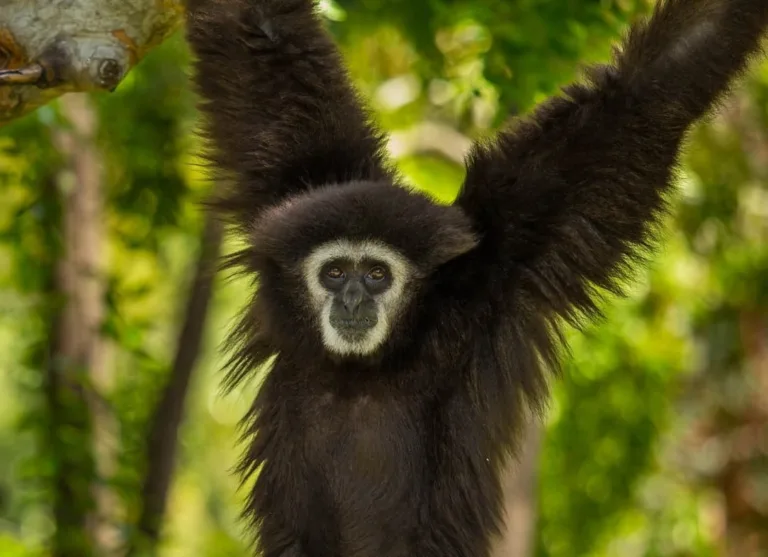
White-handed gibbons, often referred to as the lar gibbon, are considered lesser apes. Like other apes, they lack a tail and have opposable thumbs on their hands and feet. The difference between greater and lesser apes mostly has to do with size. Lar gibbons are smaller, weighing between 9-15 lbs. Lar gibbons have two color morphs, a striking blonde and a dark brown almost black color covering the entirety of their body. As their name suggests, they have white hands, along with a white ring of fur around their gray faces. Their colors are not sexually dimorphic, both colorations have been documented on either sex with the dark color morph being the dominant of the two color morphs. and there is no significant difference in size between the two morphs. Gibbons have long arms used for brachiating, which is the ability to swing from tree branch to tree branch. Their thumbs are located farther down their wrist than most apes to aid in their brachiation.
Habitat & Ecology
Lar Gibbons are found in a small section of Southeast Asia, starting from Myanmar, spreading throughout Thailand, and ending in Malaysia. Historically, these gibbons were found deeper into Asia such as into China, but that is no longer the case. Lar gibbons are arboreal, living in dense forests of bamboo, seasonal evergreen, and peat swamps. Lar gibbons are arboreal and spend a vast majority of their time high in canopy layers, rarely venturing into the understory. As with most lesser apes, Lar gibbons will avoid crossing bodies of water and prefer to stay in trees a good distance away from rivers, lakes and streams.
Diet
Lar gibbons are technically classified as omnivorous, though they are largely frugivorous. They are notoriously picky eaters: sampling bites of fruit before deciding whether to eat it. When they find an acceptably ripe fruit, they will stay close to that tree, returning multiple times a day throughout the season. Once that fruit tree no longer bears ripe fruit, lar gibbons will move on to the next seasonally ripe fruit and repeat the cycle. In addition to eating fruits, gibbons will also consume leafy plants, flowers, grasses, even insects, small invertebrates, and eggs.
Because of their diet and picky fruit-throwing habits, lar gibbons end up spreading a large amount of seeds. They are a great contributor to seed dispersal and promote new plant growth which helps maintain the forests they live in.
Behavior & Reproduction
Lar Gibbons are diurnal and social. They are active during the day, often found swinging from tree to tree or grooming each other. Grooming plays an important role in their social needs and forms strong bonds between individuals of a group. They can spend up to 10 hours a day engaging in grooming behaviors. On occasion, lar gibbons will also spend a surprisingly long time resting and sleeping throughout the day, up to 15 hours.
Another part of their social needs is their singing. While other gibbon species use their songs exclusively for their mates, lar gibbons sing for an even larger variety of reasons. Males will often sing as they patrol their territory as a way of warding off rival groups. Singing is also a courtship behavior, males and females will duet, and if it’s a match they will bond and sing for hours every day. While singing, male offspring are never involved, but interestingly female offspring can frequently be seen joining in with their mothers. Songs typically last 10-15 minutes, occurring between sunrise and noon, and can be heard from up to a kilometer away.
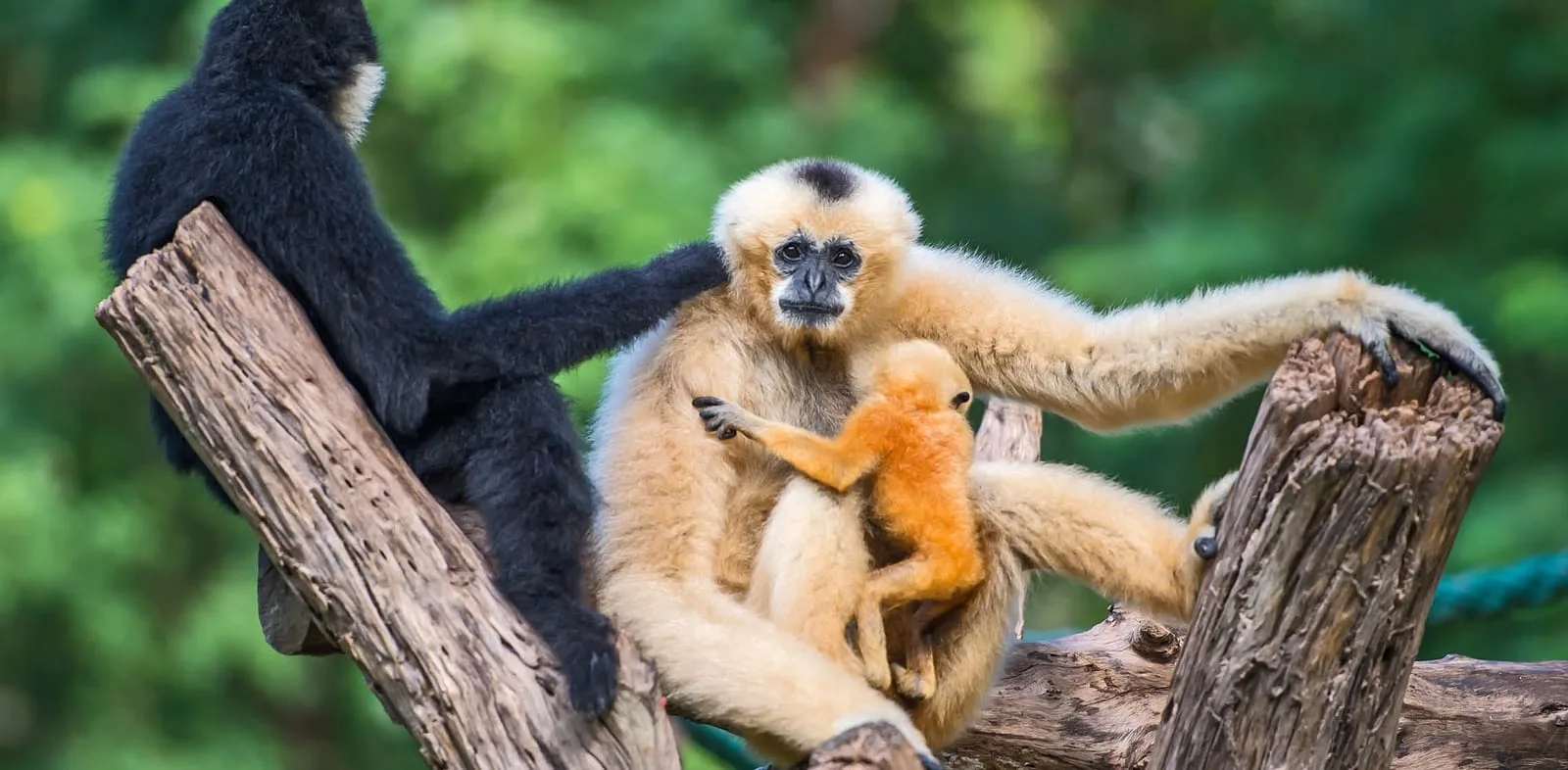
Gibbons generally live in small family groups of 2-6 individuals called troops. Lar gibbons are monogamous and usually mate for life. They will have one offspring every 3.5 years, as their offspring spend a lot of time learning from their mothers. Female gibbons are the only ones to participate in natal care, and will wean their young after 20 months. However, juvenile gibbons may stay with their parents until reaching sexual maturity at 6-9 years old.

Wild: 30 years, Protected Care: up to 44 years
Year-round
1
3.5 years
Conservation
White-handed (Lar) gibbons are currently listed as Endangered on the IUCN Red List. Unfortunately, one of the major factors to their decrease in population is habitat destruction. Many of the forests they used to inhabit have been cut down for resource mining, agricultural use or transportation. Thankfully, there are still protected forests where they live, but increased agriculture has shrunk those lands drastically. In addition to habitat loss, lar gibbons are also hunted for sport and captured for the illegal pet trade.
Fascinating Facts
- Because the lar gibbons live in tree top canopies and have their brachiating adaptation, there are no known predators of the lar gibbon. It is theorized that potential predators could include eagles, leopards, marbled cats, tigers and pythons, but nothing has been documented.
- Many lar gibbons are white at birth and don’t grow into their final color until the age of 2 to 4.
- While they usually move around by swinging, gibbons will also walk or run across tree branches bipedally with their long arms in the air for balance.
About Our Animals
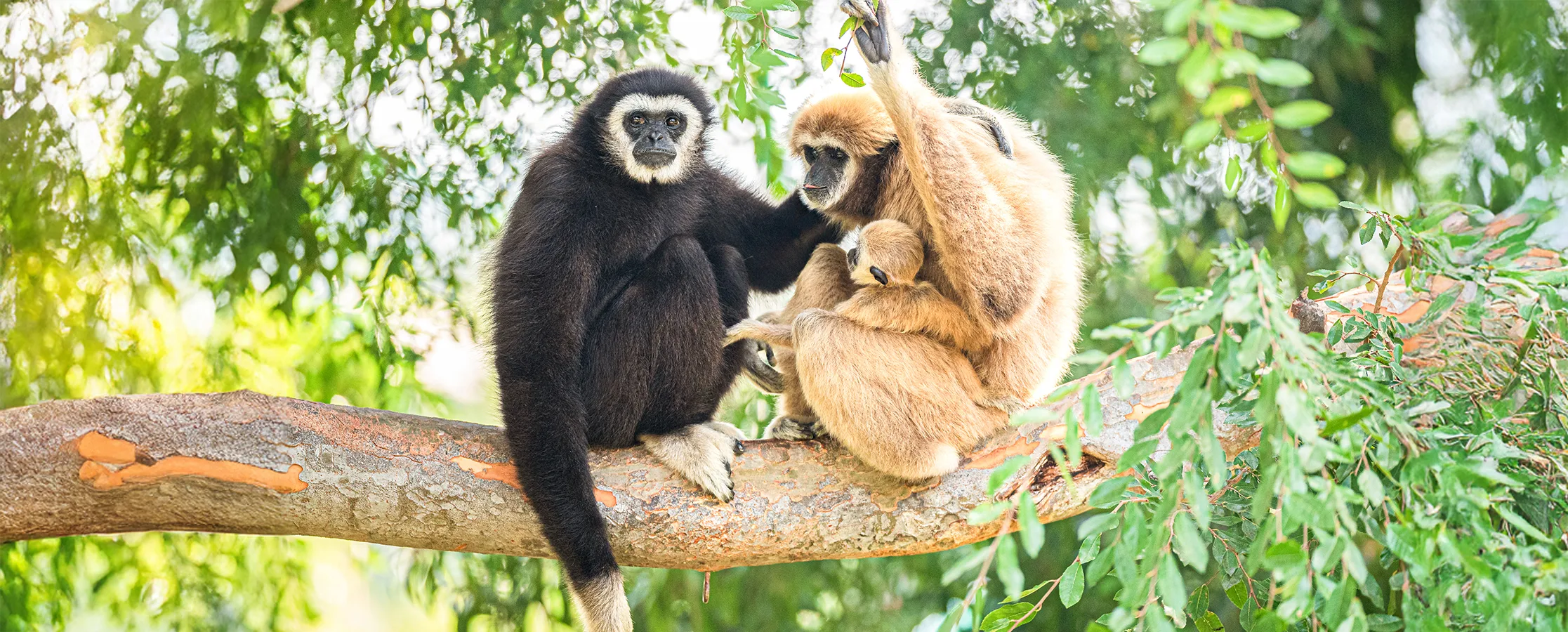
The Oakland Zoo’s family of gibbons consists of parents Mei and Rainer, and baby Joon. Rainer was born in 2012 and can be easily distinguished by his black fur. Mei, on the other hand, was born in 2011 and has golden fur. In the spring of 2019, they both joined our family at Oakland Zoo to be partnered with each other. The new pair quickly bonded and adjusted to their new lives as the heads of their own family group.
Oakland Zoo participates in a Lar gibbon breeding program, and Mei and Rainer were brought together as a potential love match. Since Lar gibbons are endangered in the wild, it’s important that breeding programs are established and maintained among the individuals in protected care. They act as ambassadors for their species, and help to diversify the gene pool of breeding gibbons. In May of 2023, baby Joon was born. Joon has golden fur, just like her mom, but is significantly smaller. She is still very young and mostly stays pretty close to momma Mei.