Oakland Zoo Provides Care for Rescued Three-Week-Old Male Mountain Lion Kitten from Southern California
Last Friday, Oakland Zoo helped rescue a three-week-old male mountain lion cub, one of the youngest the Zoo has received since joining the Bay Area Cougar Action Team (BACAT), who was orphaned in Southern California. This rescue marks the 33rd mountain lion rescue for Oakland Zoo.
The mountain lion cub was brought to the Los Angeles Zoo by staff from the National Park Service (NPS) and the California Department of Fish and Wildlife (CDFW) on March 25th. Upon arrival, the L.A. Zoo’s veterinary team conducted a thorough examination, including a physical check, blood tests, radiographs, and a CT scan. The kitten was found to be in overall good health aside from missing the toes on one foot, which had occurred in the wild. Over the next two days, the cub was bottle-fed multiple times daily, initially slowly due to several days without food, and kept in quarantine with minimal human contact.
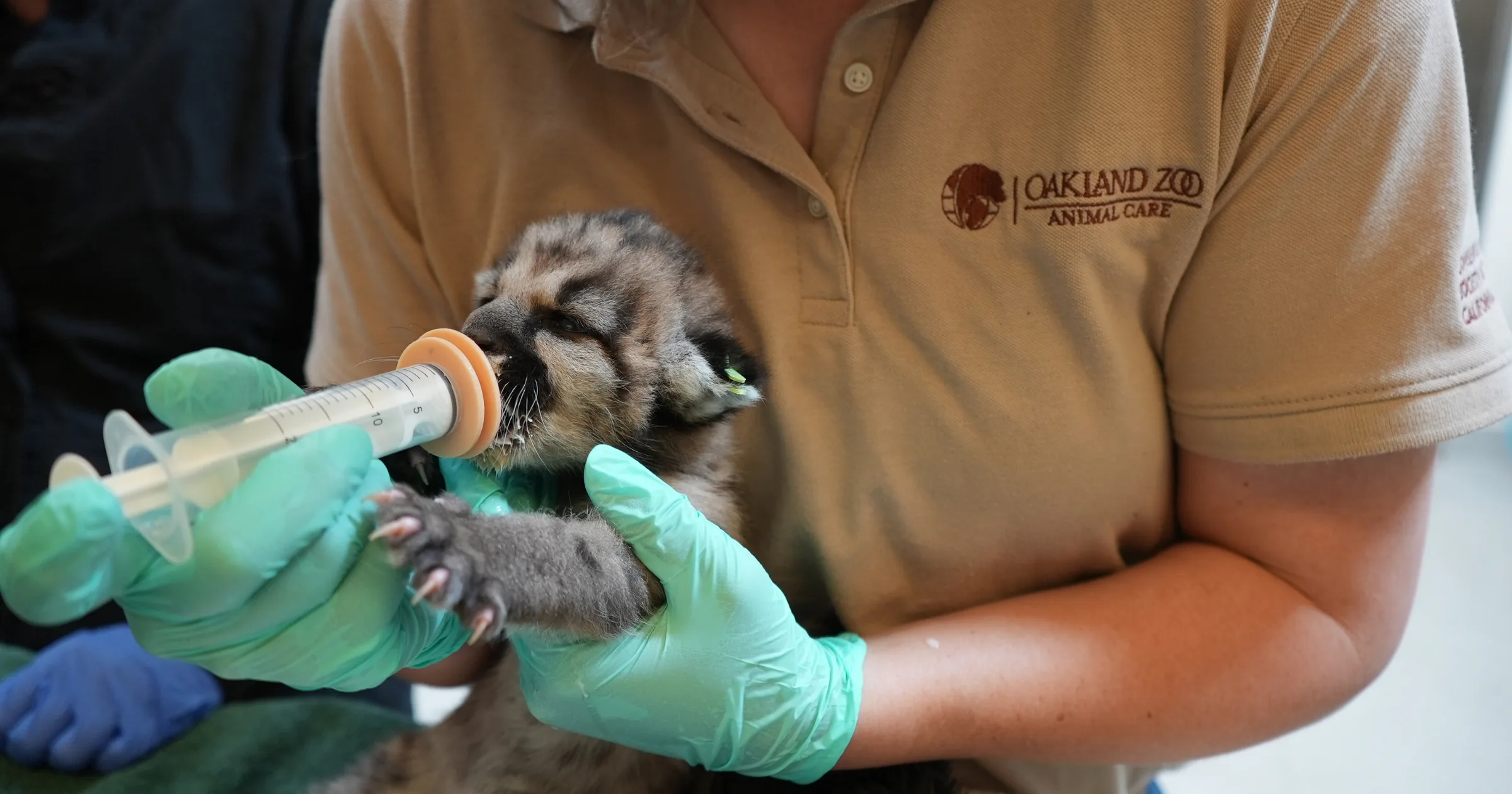
On March 27th, the kitten, now named Crimson, was transported by plane by Flying Tails Animal Rescue, where Oakland Zoo’s Animal Care staff picked up the cub and transported it to Oakland Zoo’s Veterinary Hospital. After Crimson’s intake examination, the kitten was found to be healthy. Zoo Veterinary and Animal Care staff will continue to monitor his foot closely as he grows to ensure he uses the leg properly and it doesn't cause any complications. The Zoo is optimistic that Crimson will have a good life regardless of his history. He has been handling his bottle feedings very well, and the team is feeding him around the clock due to his very young age and needs. Although his health appears good at this time, he is at a delicate stage, and the Zoo will monitor him closely as he grows.
Crimson is currently being bottle-fed every three hours by Animal Care and Veterinary staff and will continue this routine for the next few weeks. Zoo staff have the challenging task of providing the care Crimson’s mother would have offered in the wild, while also managing routine feedings and socialization, and allowing him space to exhibit wild behaviors and act as much like a wild mountain lion as possible.
“I've had the privilege of witnessing countless rescues. There is something so deeply moving about watching our team pour themselves so completely into a single life. Their skill, their sleepless nights, and their quiet determination motivate me. I can only hope that Crimson’s story and the work at Oakland Zoo impact all of you as it does me,” says Nik Dehejia, CEO of Oakland Zoo.
In the wild, mountain lion cubs need about 12-18 months with their mother to learn essential survival skills. Because Crimson is so young, he lacks the skills necessary to be released back into the wild. After he successfully rehabilitates at Oakland Zoo’s Veterinary Hospital, the Zoo hopes to introduce Crimson to Clover, the female cub rescued earlier this month, who is also receiving care at Oakland Zoo. Mountain lion kittens tend to thrive with a companion, a strategy the Zoo has successfully used with other rescues, including Briar, who has become a resident at Oakland Zoo and now lives with Silverado and Coloma at the Zoo’s California Trail mountain lion habitat. While Oakland Zoo and CDFW prefer these kittens to remain in the wild, the pairing of Clover with Crimson will help improve their overall wellbeing and secure a brighter future for both cubs.
CDFW follows a thorough process before starting rescue and rehabilitation efforts for wild mountain lions. In this case, Crimson was found alone and vocalizing frequently, which is unusual for a solitary mountain lion kitten to do for long periods. The National Park Service made multiple den visits, monitored GPS collar and camera data, and continued observing the kitten. NPS biologists observed that Crimson’s mother had likely moved dens, and she was not returning to care for him. After 2 days, he appeared noticeably weaker, having lost 10% of his body weight, prompting NPS, in close consultation with CDFW, to retrieve and relocate him for rehabilitation.
Oakland Zoo will continue to update the public on Crimson’s recovery and future introduction to Clover on social media.
For more information, please review our FAQ below…
What happened to Crimson’s mom, and what could have possibly led to him being abandoned? Is this rare?
Mountain lions rarely abandon their offspring, and it is also uncommon for a mountain lion to have only one kitten in a den. While CDFW cannot officially confirm why the mother abandoned the kitten, she may have done so because of the kitten's abnormal hind limb, specifically the missing toes, which could have triggered an instinct in the mother to relocate her other potential kittens and conserve resources by establishing a new den site.
What are the next steps before Crimson is introduced to Clover?
Before Crimson can be introduced to Clover, he is going to need to be larger and more robust. Currently, he is much smaller than Clover, and for his safety, the team needs to wait for him to grow so they can play appropriately.
Oakland Zoo Veterinary and Animal Care staff may start “fenceline howdies” between Clover and Crimson when he is ready, so they can get used to each other’s presence before introducing them physically in the same space.
How is Clover doing? The female mountain lion who was rescued in early March.
Clover has been recovering well, is currently stable, and is getting close to her ideal body weight for her age. She is getting used to the Zoo and hospital environment and is beginning training with Animal Care staff.
Why did the kitten have an ear tag upon arrival? How do researchers track mountain lions?
Mountain lion researchers use ear tags so that animals can be identified in the future, if they are captured, or found to have died, or seen in a photo. The National Park Service has been studying the small, isolated mountain lion population in the Santa Monica Mountains for more than 20 years to better understand their behavior and ecology and how to conserve them. Understanding how often females reproduce, how many kittens they have, and the fate of those kittens is a critical part of that work. In general, researchers track mountain lions using GPS and VHF radio-collars.
What conservation challenges do mountain lions face in the wild?
Mountain lions encounter numerous conservation challenges in the wild. Their habitats are increasingly fragmented as new communities encroach, slicing through mountain lion territories and blocking essential movement pathways with highways and buildings. Human expansion increases the risk of fatal car strikes; when a mother mountain lion is hit, her cubs often cannot survive without her for food and guidance. Additionally, like many other wild animals in California, mountain lions are threatened by wildfires driven by climate change.
What is the Bay Area Cougar Action Team (BACAT)?
In 2012, the Oakland Zoo participated in a training session focused on resolving conflicts between humans and wildlife. This training led to the formation of BACAT (Bay Area Cougar Action Team). The alliance brings together various agencies, non-profit organizations, local parks, and mountain lion researchers. With a shared message and a team-based approach, BACAT aims to create a support system that serves as a model for other regions in California and beyond. Through BACAT, Oakland Zoo has rescued and rehabilitated over 30 mountain lions, most of whom were victims of human-wildlife conflicts or wildfires.
How much does it cost Oakland Zoo to care for mountain lion cubs?
Cubs arrive at the Oakland Zoo with varying medical needs and symptoms; some stay only a matter of weeks, while others may remain for many months. On average, mountain lion cubs spend 8.5 days in the Intensive Care Unit at the Wayne and Gladys Valley Veterinary Hospital, which requires constant staff care. The average cub costs roughly $18,000 per month for veterinary and animal care. These efforts are supported by community donations.
How can you help support Oakland Zoo and its Mountain Lion Rescue and Recovery program?
Oakland Zoo relies on community philanthropic support to fund our conservation and animal welfare programs, including our mountain lion rescue and recovery work. You can make a donation to Oakland Zoo online at www.oaklandzoo.org/give or reach our Development team at impact@oaklandzoo.org.