African Spoonbill

Least Concern
Wetlands
Sub-Saharan Africa
Diurnal
Carnivorous
Flamingo Plaza

Characteristics
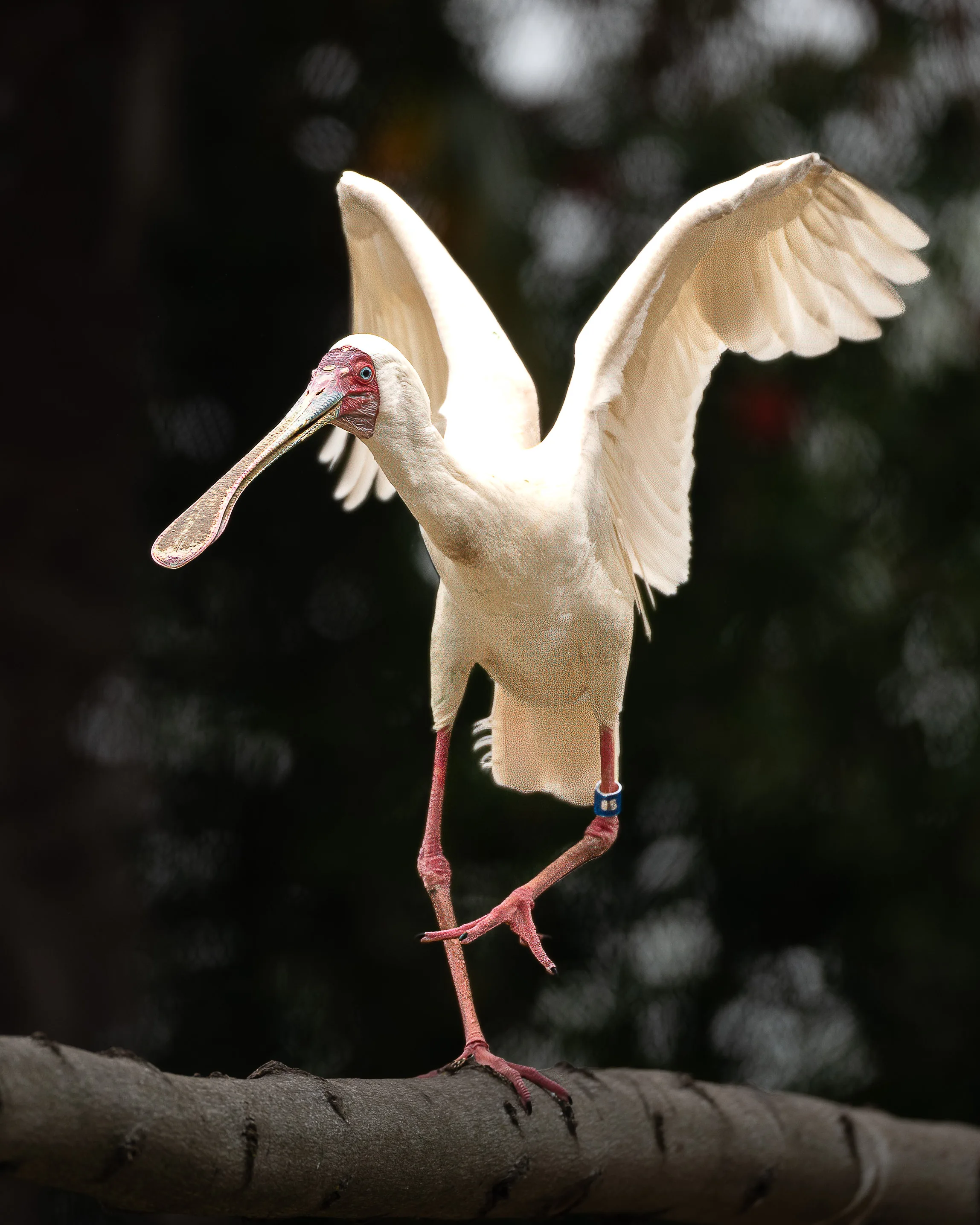
African spoonbills are medium-sized waterbirds that are covered in pure white feathers. They stand roughly 3 feet in height and weigh almost 4 pounds. Their long legs and bald faces are covered in bright pink-red skin, and they have a long and distinctive spoon-shaped bill that gives them their name. Juveniles lack the brighter skin color and instead have a dark gray almost black coloration.
Habitat & Ecology
African spoonbills can be found across sub-Saharan Africa. Their range spans from Senegal eastward to Ethiopia and Eritrea, and southward down to South Africa. They are also found on Madagascar. They are waterbirds that prefer freshwater wetlands, like lakes, marshes, and reservoirs. It is rare to find them in saltier areas like estuaries and coastal lagoons.
Diet
African spoonbill are carnivores and feed on small fish and aquatic invertebrates like molluscs and crustaceans. In some regions, the primary diet observed being brought back to feed their chicks was also frogs.
Spoonbills are aptly named for the shape of their bill, which is long, flat, and shaped like a spatula at the end. They filter feed by wading in shallow water and siphoning water into their beaks by moving it from side to side. Water passes through the beak, but small fish and crustaceans get caught.
Behavior & Reproduction
African Spoonbills are most active during the day, making them diurnal. They are social and often found in groups of 3-30 individuals. At night, they come together to roost in large numbers of up to 1,000 in trees or reedbeds.
Breeding usually occurs in the wet season but can vary depending on locality. During the breeding season, African Spoonbills will nest colonially with other species in groups of up to 250 pairs. Their nests are flat, oval shaped, and made of sticks or reeds. Their clutch size is usually 2-3 eggs, and they are incubated for 25-29 days. Young spoonbills become independent at 46 days.
15-17 years
Nov-Jan
2-4
1 year
Conservation
African Spoonbills are currently listed as Least Concern by the IUCN. Their global population is unknown, but it is believed to be between 10,00-100,000 individuals on continental Africa. In Madagascar, there are around 1000-5000 birds. In Madagascar, the African Spoonbill is threatened by habitat loss and destruction of breeding colonies.
Fascinating Facts
- Spoonbills start life with a short bill that grows longer and more distinctly shaped as they age. By the time they’re ready to leave the nest and start to fly, their bill has grown long and distinctively spoon shaped.
- There are six species of spoonbills, and African spoonbills are the only ones that are primarily found in Africa.
- Spoonbills are closely related to ibises!
About Our Animals
The Oakland Zoo has three resident African Spoonbills. Billy was hatched in 2008 and has lived at our zoo since he was 1 year old. Winny and Wonnky joined us in 2024. They live with our flamingoes and Hadada Ibis.