Bald Eagle
Least Concern
Forest
North America
Diurnal
Carnivorous
California Trail
Characteristics
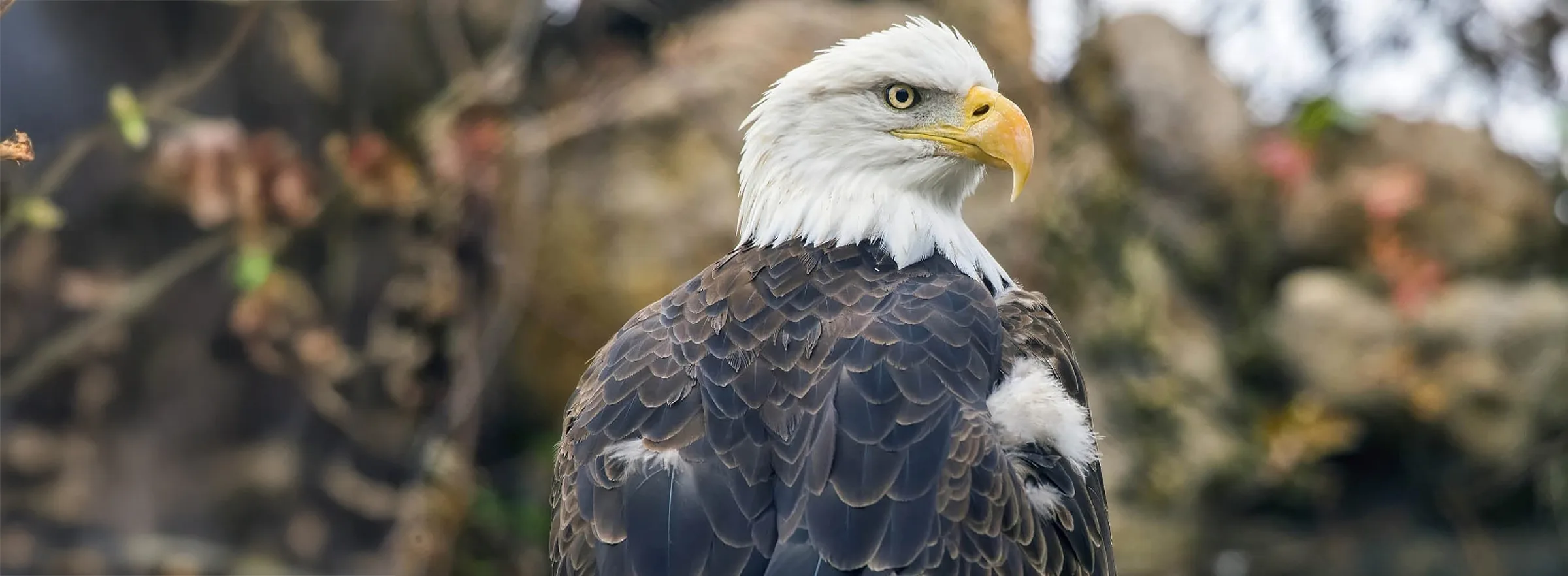
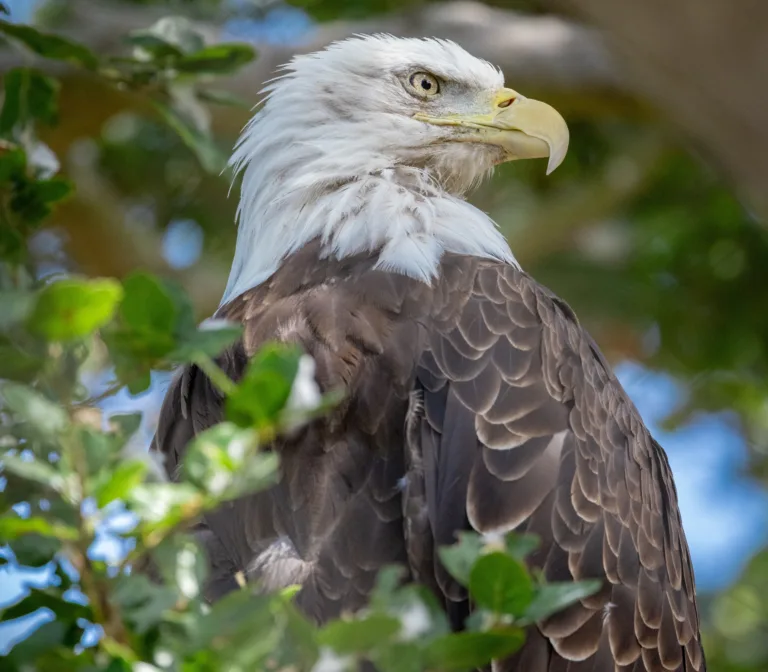
Bald eagles are one of the largest birds in North America, with a wingspan that can reach over 6.5 feet long. They have heavy bodies covered in dark brown feathers, and a distinctly white head and tail. Their eyes, feet, and hooked beak are all strikingly yellow. Their wings are broad and the primary feathers at the end are separate, giving the illusion of “fingers”. There are only two species of eagle in the United States, the bald eagle and the golden eagle. The bald eagle’s white head and tail are the easiest way to distinguish the two.
As with most raptors, bald eagles have little sexual dimorphism. Females tend to be larger, but there is a lot of overlap between the sexes. Bald eagles usually can weigh anywhere between 6.6 and 13.8 pounds. Juveniles lack the distinct white head and tail that adults have. As they age, they begin to grow in more and more white feathers until they reach their adult plumage, typically in around 5 years. Similarly, they hatch with black eyes and beaks that don’t turn yellow until they are around 3 years old.
Habitat & Ecology
Bald eagles are found all throughout North America. As far north as Alaska, and as far south as Mexico. Many bald eagles fly to Canada for the breeding season and live in the United States and Mexico during the non-breeding seasons. However, there are also year-round populations established in each of these countries. They nest in forests, but stay along the coast, or areas with rivers, lakes, or reservoirs. Since fish make up a large portion of their diet, these birds are often found nesting within 2 miles of a water source.
Bald eagles are considered apex predators. Due to their large size and ability to fly away from danger, they have no natural predators. Because they are top predators, they help with population control of many different species.
Diet
Despite being considered apex predators, bald eagles usually better fall into the category of opportunistic foragers. Rather than catching their own food, bald eagles prefer to either feed on carrion or steal fresh catches from other animals. The bulk of their diet comprises fish such as salmon, herring, shad, or catfish. Their usual victims are Ospreys, who are expert fish hunters, but they will also steal from any other carnivorous bird or even foxes and otters. Their large size makes it easy for them to push around other animals. This applies to when they feed on carrion as well. As they feed on the carcass, they push aside other scavengers like Turkey Vultures and crows.
Bald eagles will also hunt their own prey. They are known for hunting fish and other marine animals, but they will also go after anything from smaller birds, to reptiles, to small mammals. When food is scarce, they gorge on their food and will spend the next several days digesting it. Because of this, they can survive fasting for days and even weeks.
Behavior & Reproduction
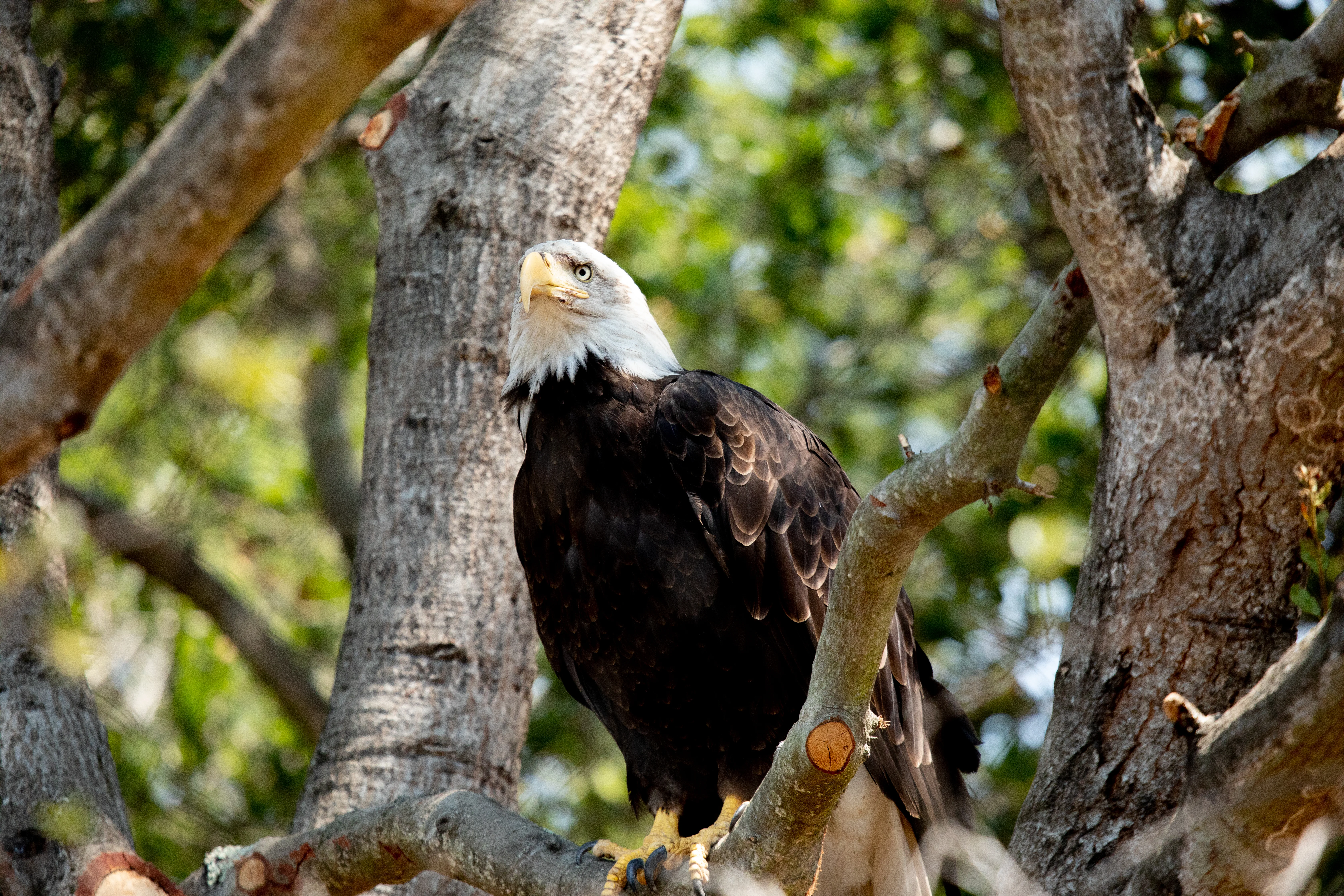
Bald eagles are powerful fliers-soaring, gliding, and flapping over long distances. Their large broad wings are easy to spot as they soar through the open sky. They tend to rest at the tops of tall trees. When on the ground, they can walk, but with an awkward gait. They are capable of floating and may use their wings to “row” themselves and wade in the water.
Bald eagles are solitary, as is typical for birds of prey, and are usually only seen in pairs around the breeding season. Bald eagles are monogamous and are believed to mate for life, returning to the same mate every year. They have spectacular courtship displays: flying high up in the sky, the mating pair will lock talons, then cartwheel down together, letting go at the last second to avoid crashing down. The nests they build can get as big as 6 ft in diameter, and up to 4 ft tall. Because of the nest’s heft, it can take up to three months to build. Bale eagles will often reuse their nests year after year. Both males and females take turns in caring for the eggs and eventual chicks. These chicks start flying at 12 weeks and can then spend another 4-12 weeks learning how to fly well and hunt. An immature bald eagle may spend the first 4 years of its life in nomadic exploration. Looking for the right territory before choosing one area.
Wild: 15+ years, Protected Care: 30-50 years
Variable within January-August
1-3
Yearly
Conservation
Bald Eagles have been threatened by many human-driven issues over the last several hundred years. Beginning in the mid-1800s, Bald Eagles were heavily hunted. On reason they were targeted was due to the belief that they were preying on livestock. Thankfully, this myth has been debunked, but it was a very serious issue at the time. In 1940, the Bald Eagle Protection Act was passed, banning the killing, selling, and possessing of Bald Eagles. This allowed for Bald Eagles to begin regaining their population status.
However, in the 1960s, the Bald Eagle once again found itself facing the threat of extinction, this time due to a more indirect cause. A pesticide called DDT gained popularity among farmers. It’s heavy use led to the poisoning of waterways from farm run-offs. This posed a major threat to birds of prey that relied on large bodies of water for food. The effect of DDT meant that egg shells were incredibly soft and fragile. The eggs couldn’t support the weight of an adult sitting on them to incubate. This led to a drastic drop in successful clutches. Birds like Bald Eagles, Peregrine Falcons, and Ospreys found themselves facing a major threat to their survival. In 1963, there were only 417 breeding pairs of Bald Eagle.
Luckily, DDT was banned in 1972, and wildlife conservationists went into action. Bald eagles were added to the federal list of endangered species in 1967 for protection. In 2007 they were taken off this list, but are still protected under the Migratory Bird Treaty Act, as well as California Law. As of 2019, there are 71,467 breeding pairs in the wild and Bald Eagles are listed as Least Concern on the IUCN Red List.
Even though DDT has been banned, and their population is increasing, Bald Eagles still face threats. Windmills, habitat modification from housing and agriculture, and power lines are all still barriers in increasing their population in certain regions.
Fascinating Facts
- In popular media and movies, you have probably seen a depiction of a Bald Eagle soaring high in the sky, letting out a fierce call. This call is not actually from a Bald Eagle at all! The famous Red-tailed Hawk screech is usually used in media to represent the calls of all raptors. Bald Eagles actually have a call more similar to seagulls, with their high-pitched calls sounding like “kwit-kwit-kwit, kee-kee-kee-ker.”
- When people hear the word “bald,” they are sometimes mislead to think that Bald Eagles have no feathers on their head. In reality, the word bald derives from the old English word “balde,” meaning white. That is why they are called Bald Eagles!
- The largest Bald Eagle nest on record, in St. Petersburg, Florida, was 2.9 meters (9.5 ft) in diameter and 6.1 meters (20 ft) tall. Another famous nest—in Vermilion, Ohio—was shaped like a wine glass and weighed almost two metric tons. It was used for 34 years until the tree blew down.
About Our Animals
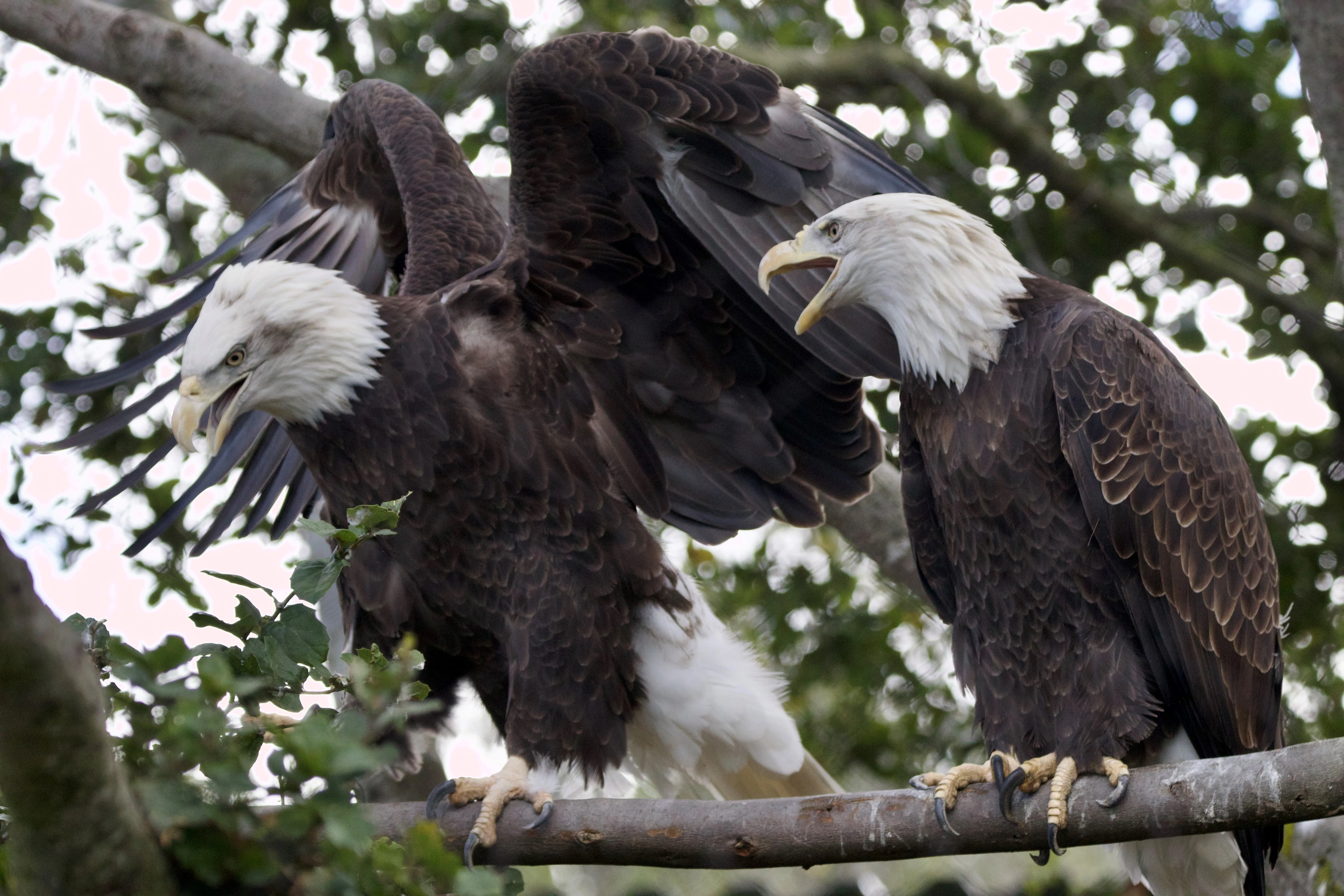
The Oakland Zoo has two bonded female Bald Eagles, Berryessa and Shasta. They came to us from the Raptor Education Group in Wisconsin in 2018. Berryessa and Shasta have both, unfortunately, sustained injuries that impair their movement, deeming them non-releasable. Berryessa is estimated to have hatched in 2015 and is the loudest of the two. Her favorite spot is roosting in the front right tree. Shasta is estimated to have hatched in 2013. She likes to perch near Berryessa, and therefore they are usually both spotted in the same tree! Shasta often has her head feathers arranged in a small mohawk that can make it easier to tell her apart.
Our Role
Oakland Zoo partners with Ventana Wildlife Society who has successfully worked to increase bald eagle populations. Oakland Zoo works to spread the word about rat poison and its deadly effect on raptors. Here are some things you can do to help:
- Use nontoxic pesticides, herbicides, fertilizers & other chemicals; use all other chemicals only in accordance to law.
- Help protect old growth trees, particularly within a mile from water, and other roost/nest sites and important foraging areas.
- Avoid boating and fishing near foraging areas & during peak feeding times.
- Contact representatives and government organizations to express your interest in bald eagle conservation.
- If you see an eagle or nest, please let Ventana Wildlife Society know If you see an eagle pair you want to protect, ask VWS to help support you with this noble endeavor.