Blue-Fronted Amazon
Near Threatened
Grassland and open woodland
South America
Diurnal
Herbivorous
Tropical Rainforest

Characteristics
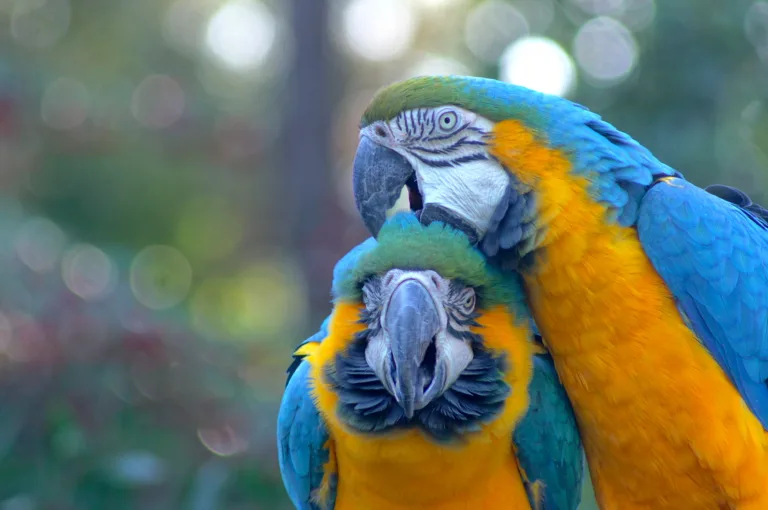
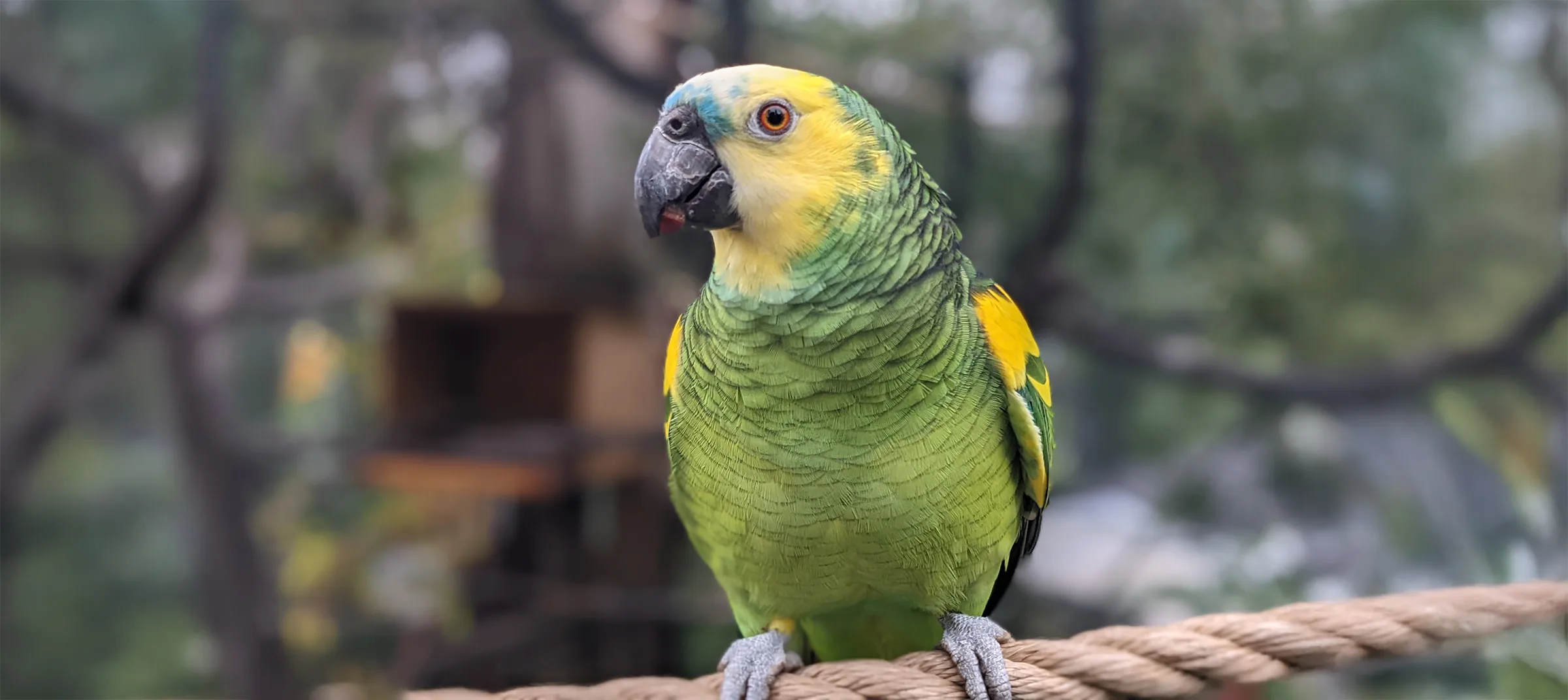
ke most amazons, Blue-fronted Amazons are predominantly covered in green feathers. Most of their face is yellow, with the exception of the area right above the beak, which is a striking blue or turquoise. The yellow and blue areas on the face vary between individuals and can be used to tell them apart. There is no visual indicator of sex to the human eye. However, studies indicate there may be sexual dimorphism visible to the avian eye that can be seen with the UV spectrum.
Blue-fronted Amazons have orange-red eyes ringed with white skin. They have red feathers on their shoulders, wing patches, and under their tail. Their primary feathers are tipped in dark blue. Males and females are both about 13-15 inches long and weigh a little under a pound.
Habitat & Ecology
The Blue-fronted Amazon can be found in the Amazon Rainforest in northeastern Brazil, down through Bolivia and Paraguay to northern Argentina. There are also feral populations found in other countries such as Mexico, Puerto Rico, Uruguay, Chile, and the USA.
Blue-fronted Amazons prefer lower-elevation open habitats such as Cerrado and Chaco scrub, savannas, floodplains and palm groves, and will even be found in urban areas. They are also found in old-growth forested areas such as gallery forest, riparian woodland and subtropical woodland.

Diet
Amazons are all herbivorous and highly frugivorous. They will also eat a wide variety of seeds and nuts from different plants. They are very adept at using their feet to grab and secure their food as they forage and eat. They also use their beaks and tongues as tools to peel their food.
Behavior & Reproduction
Blue-fronted Amazons are social birds that spend most of their time with their mated pair. They are also part of a larger flock that forages and roosts together. Blue-fronted Amazons are non-migratory, but make nomadic movements from habitat to habitat within their home range based on seasonally-available food.
Blue-fronted Amazons pair-bond for life, though little is known about courtship displays. Breeding season is variable across their range and typically lasts 3 months. In some areas, it begins in August and ends in September, and in other areas it starts later in October and ends in December. Nesting is highly synchronized, so all females in the region will nest and lay eggs within the same 2 weeks. Females lay 2-3 eggs in the natural cavities of old-growth trees. Females incubate the eggs for a little under a month before they hatch, at which point both parents feed the chicks via regurgitation. The chicks are ready to leave the nest at 56-60 days, but remain with the parents for 9 weeks.
Wild: 35 years, Protected Care: 70 years
August-December
2-3
Yearly
Conservation
Blue-fronted Amazons are listed on the IUCN Red List as Near Threatened (2019) and are on the CITES Appendix II. This species is one of the most abundant of South American Amazon parrots, as it benefits from agriculture and can live in disturbed areas. Despite this, the global population is declining.
The biggest threats for this species include habitat loss, collection for the illegal pet trade, and climate change. While they benefit from agricultural areas because it provides food for them, the loss of mature trees with natural cavities due to logging equates to a loss of nesting habitat. Additionally overgrazing by domestic livestock and oil exploration are affecting parts of their range. They are also heavily trapped for the pet trade, with an estimated 244,774 individuals exported from Argentina alone from 1985-1990.
Fascinating Facts
- The Blue-fronted Amazon is also sometimes called the turquoise-fronted Amazon.
- Why can parrots mimic human speech? Parrots have an especially well-developed region of the brain dedicated to vocal learning. They are used to picking up on vocalizations and mimicking them to fit in with the flock. When surrounded by humans, this means they try to copy us to fit in!
- There are two subspecies of blue-fronted amazon: Amazona aestiva aestiva and Amazona aestiva xanthopteryx. A. a. xanthopteryx can be distinguished by looking for the yellow patch of feathers on their shoulders. This subspecies is sometimes considered to be a different species entirely.
About Our Animals
Oakland Zoo’s resident blue-fronted amazon is Alotta! Alotta was hatched in 2003 at the Franklin Zoo in Massachusetts and came to live with us in 2021. He is housed with two other species of amazon parrot. Among the flock, Ringo the lilac-crowned amazon is the most dominant of the three. However, Alotta likes to challenge his title from time to time and they can sometimes be seen in a posturing stand-off.
Our Role
The Oakland Zoo has partnered with ARCAS, a non-profit Guatemalan organization that works to end the illegal wildlife trade in South America and rehabilitate affected animals.
If you are interested in having a parrot as a pet, do extensive research before deciding. Parrots are long-lived birds who may outlive their human caretaker. They require lots of stimulation, enrichment, and attention. If you are determined to get a parrot, please consider getting a rescued parrot as opposed to a young/baby parrot to avoid the risk of getting a parrot that was smuggled from the wild (a very traumatic experience for birds) and supporting the illegal wildlife trade. The Oakland Zoo is a conservation partner to Mickaboo Companion Bird Rescue, a good organization to adopt from.