Blue-and-Yellow Macaw
Least Concern
Forest
South America
Diurnal
Herbivorous
Tropical Rainforest
Characteristics
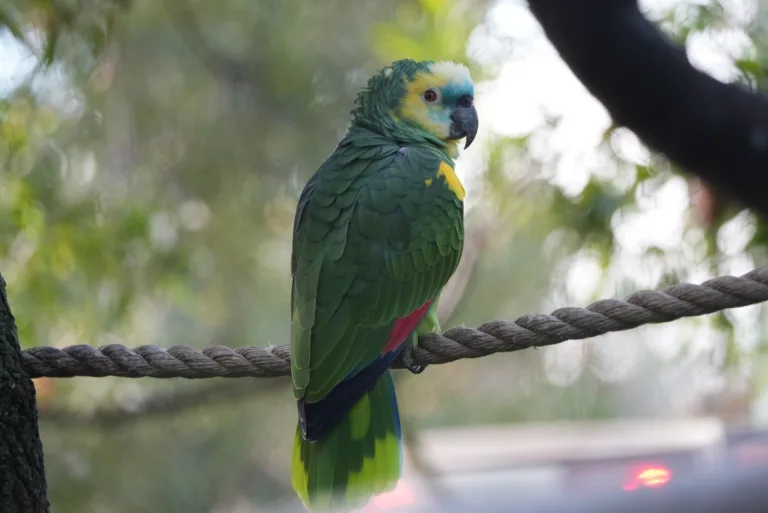
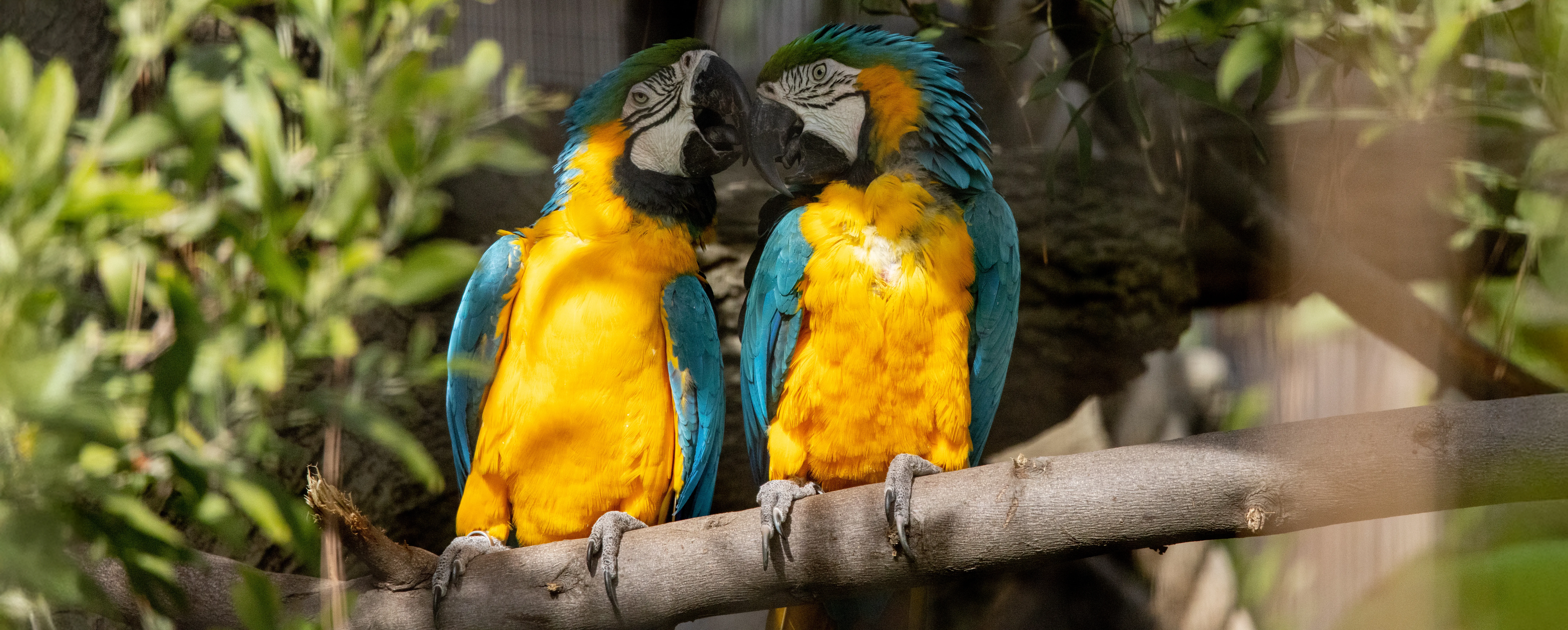
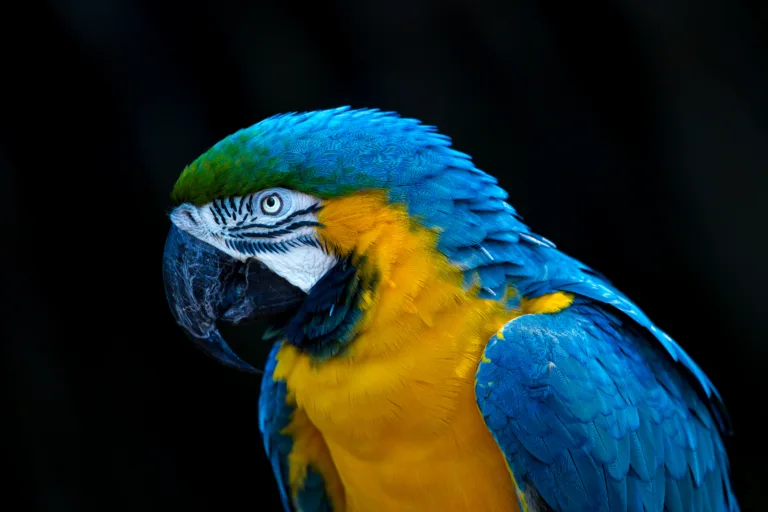
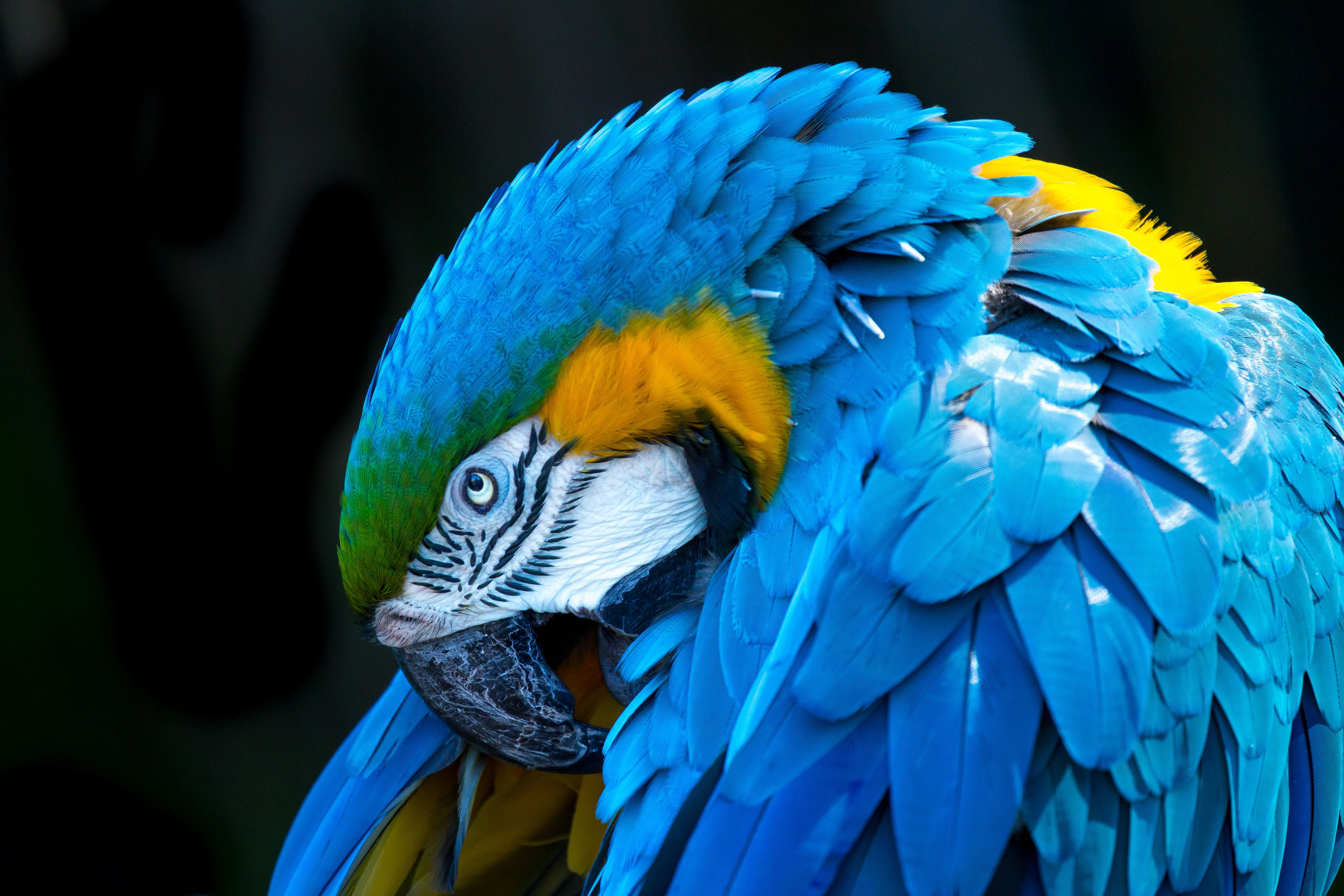
Blue-and-yellow macaws are large, 3-foot-long parrots that can weigh up to 3 pounds. They are mostly blue, with darker blue on the flight feathers and tail. Their foreheads are green-blue, and their underside is yellow. The yellow begins on the side of the neck and extends down the chest, belly, wings, and legs. Their undertail coverts are a dull turquoise. They have black feathers on their neck bordering their pale white facial skin that is marked with black streaks around the eyes. Immature individuals have dark or gray eyes that turn yellowish-white as they get older. Their legs are gray, and their bills are black. Males and females are impossible to tell apart visually. Their wingspans are over 3.5 feet long.
Habitat & Ecology
Blue-and-yellow macaws are found in South America throughout most of Brazil. They are also found in the countries bordering Brazil from the west to the north spanning Bolivia to French Guiana.
Like most macaws, blue-and-yellow macaws prefer swampy tropical and subtropical forest habitats. They also inhabit seasonally flooded forests, riparian areas, palm savannas, and are rarely found in higher altitudes. However, they are considered habitat generalists and are also found in many urban areas.
Diet
Blue-and-yellow macaws are herbivores with a preference for seeds, grains, nuts, fruits, leaves, and flowers. They especially value seeds with high lipid and protein content, but their diet changes seasonally with fluctuating food availability.
Macaws have a very powerful beak and tongue that helps them with their diet. Their beaks are large and powerful with a flexibility unattainable by most other animals. As humans, our upper mandible is fixed, meaning we can only move our lower jaw independently. In birds, the upper mandible is not fixed, adding an extra degree of flexibility. Parrots in particular have an astounding ability to move their upper and lower jaws independently. This allows them to do such things like peeling fruits and seeds in their mouths using only their beaks.
Behavior & Reproduction
Blue-and-yellow macaws are highly social and are most likely to be spotted foraging in the early morning or afternoon in flocks of up to 25 individuals. Within the flock, individuals will usually pair up and fly and forage with a partner. During midday, they seek shade high up in trees in smaller flocks or pairs. At night, they roost in large family groups. The largest flocks form around riverbanks where macaws will congregate to eat clay, which aids their digestion. Blue-and-yellow macaws are not considered migratory, but they are nomadic. Their use of habitat depends on food availability, and they may travel up to 15 miles a day to find it.
Mating season for blue-and-yellow-macaws takes place from November to February in some areas and February to May in others. Macaws reach maturity at around 3 to 4 years of age and will form bonded pairs that stay together until one of them dies. During mating season, pairs will leave the flock to find a nesting site. They favor pre-existing cavities in tall trees such as dead Mauritia palms. Females will lay 2-3 eggs and incubate them for a little under a month. Females feed the chicks for the first week of their life, but the males start helping after the first week. Fledglings are ready to leave the nest at 3 months and become fully independent 3 weeks later.
35-50 years
Nov-Feb or Feb-May
2-3
1-2 years
Conservation
Blue-and-yellow macaws were last assessed by IUCN in 2018 and listed as Least Concern on the Red List. On CITES, it is listed on Appendix II, meaning that while it is not threatened with extinction, trade of the blue-and-yellow macaw must be controlled to preserve the species in the wild.
The wild population of blue-and-yellow macaws is in steady decline, largely due to habitat loss and illegal poaching for the pet trade. In Tobago they are considered regionally extinct, and were once regionally extinct in Trinidad, but successful reintroduction was implemented in the 2000s. In Brazil, the blue-and-yellow macaw is considered critically endangered in the State of Sao Paulo, nearly extinct in the State of Rio de Janeiro, and vulnerable in the State of Minas Gerais.
Fascinating Facts
- Macaws have a noticeably long tail. Their tails help to navigate and balance as they fly through the forest and are used as a brace when landing in the opening to a tree cavity where they nest.
- Salt is an important mineral that is usually obtained from food, but because the Amazon has such a low salt quantity, macaws must take a more extreme measure and eat clay to supplement their salt intake!
- Blue-and yellow macaws have a typical countershading pattern. Countershading occurs when an animal is darker when looked at from above and lighter when looked at from below. This is because when we look up at them, the lighter belly and under-wing feathers blend into the sky, and when we look down on them, their darker back and wing feathers blend into the dark ground.
About Our Animals
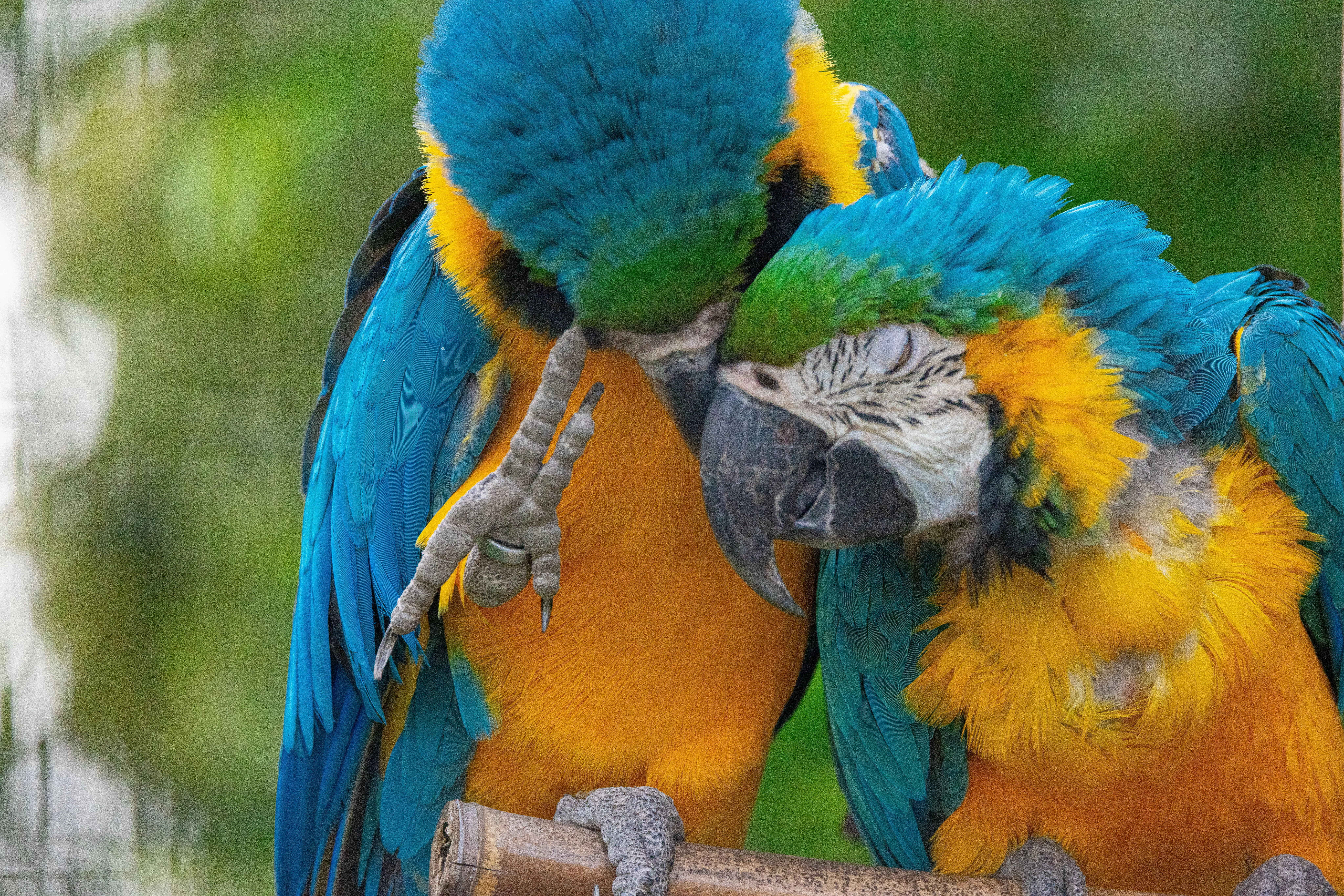
Oakland Zoo has an all-male flock of 3 blue-and-yellow macaws. Bobaloo and Bingo have lived with us since 1997. They are the two oldest of the macaws and are close with each other. You can tell them apart because Bongo has a metal band around his leg. They are both a little more reserved than the younger macaws and are happy to sit back and observe the keepers and wait for their turn during training sessions.
Paco is our third blue-and-yellow macaw. He is a very quick-thinking bird that is always ready for training and wants to know what the keepers are doing right away. Paco came to us in 2002 after living with a private owner for 8 years. Macaws are popular pets because of their bright colors and playful personalities. However, many people don’t consider how much attention and care they require, or the many decades they can live for.
Our Role
Oakland Zoo has partnered with ARCAS, a non-profit Guatemalan organization that works to end the illegal wildlife trade in South America and rehabilitate affected animals.
If you are interested in having a parrot as a pet, do extensive research before deciding. Parrots are long-lived birds and may outlive many humans. They require lots of stimulation, enrichment, and attention. If you are determined to get a parrot, please consider getting a rescued parrot as opposed to a young/baby parrot to avoid the risk of getting a parrot that was smuggled from the wild (a very traumatic experience for birds) and supporting the illegal pet trade. Oakland Zoo is a conservation partner to Mickaboo Companion Bird Rescue, a good organization to adopt from.