Hooded Vulture

Critically Endangered
Desert, Grassland, Forest, and Wetland
Sub-Saharan Africa
Diurnal
Carnivorous
African Savanna
Characteristics
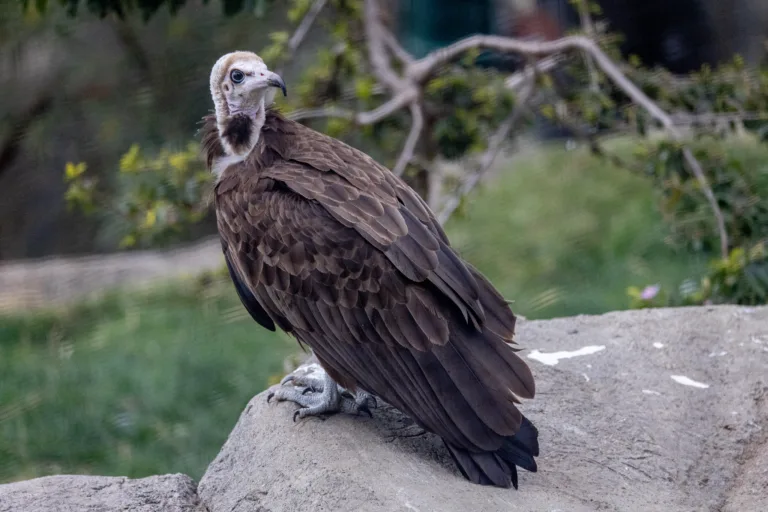
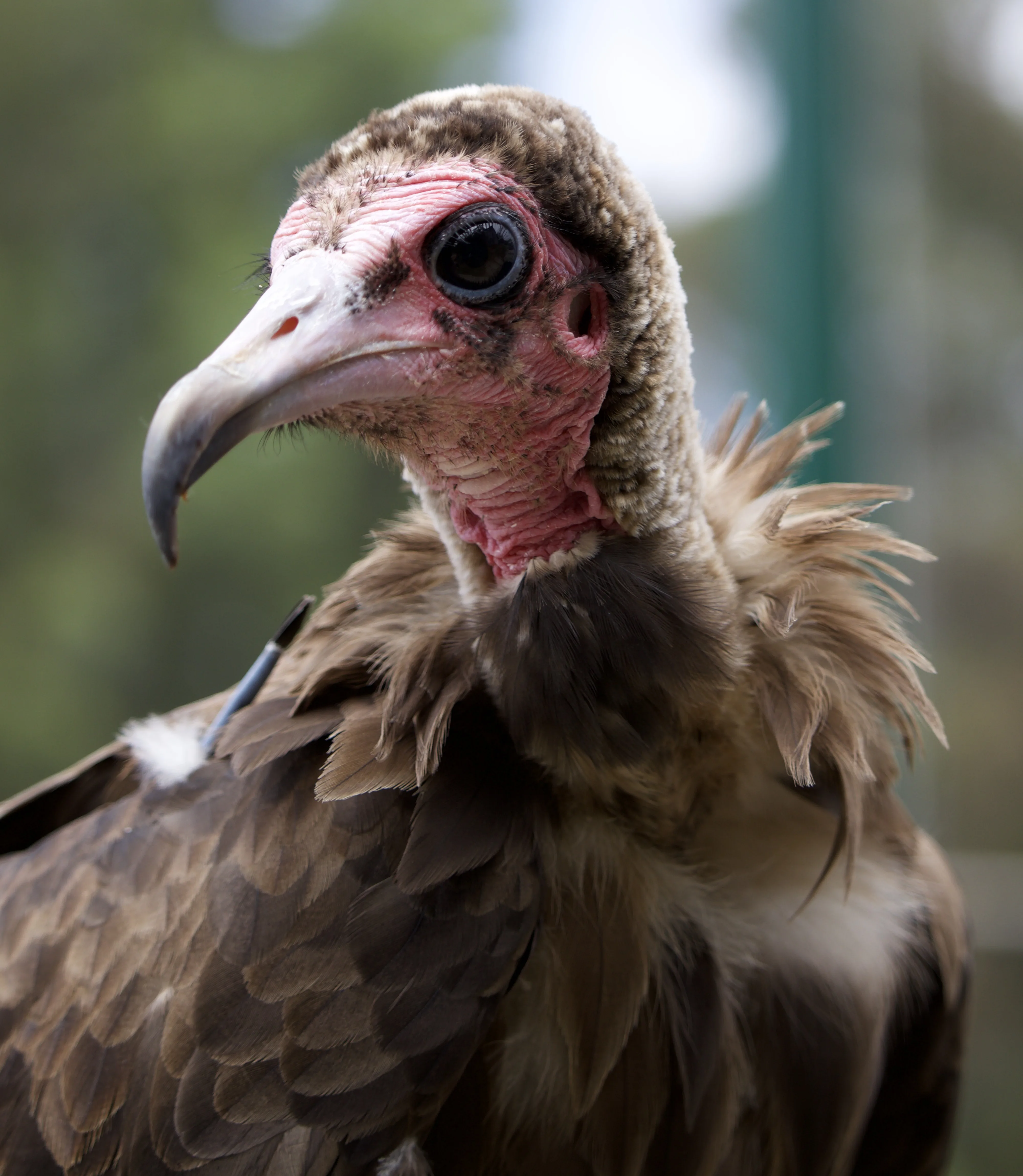
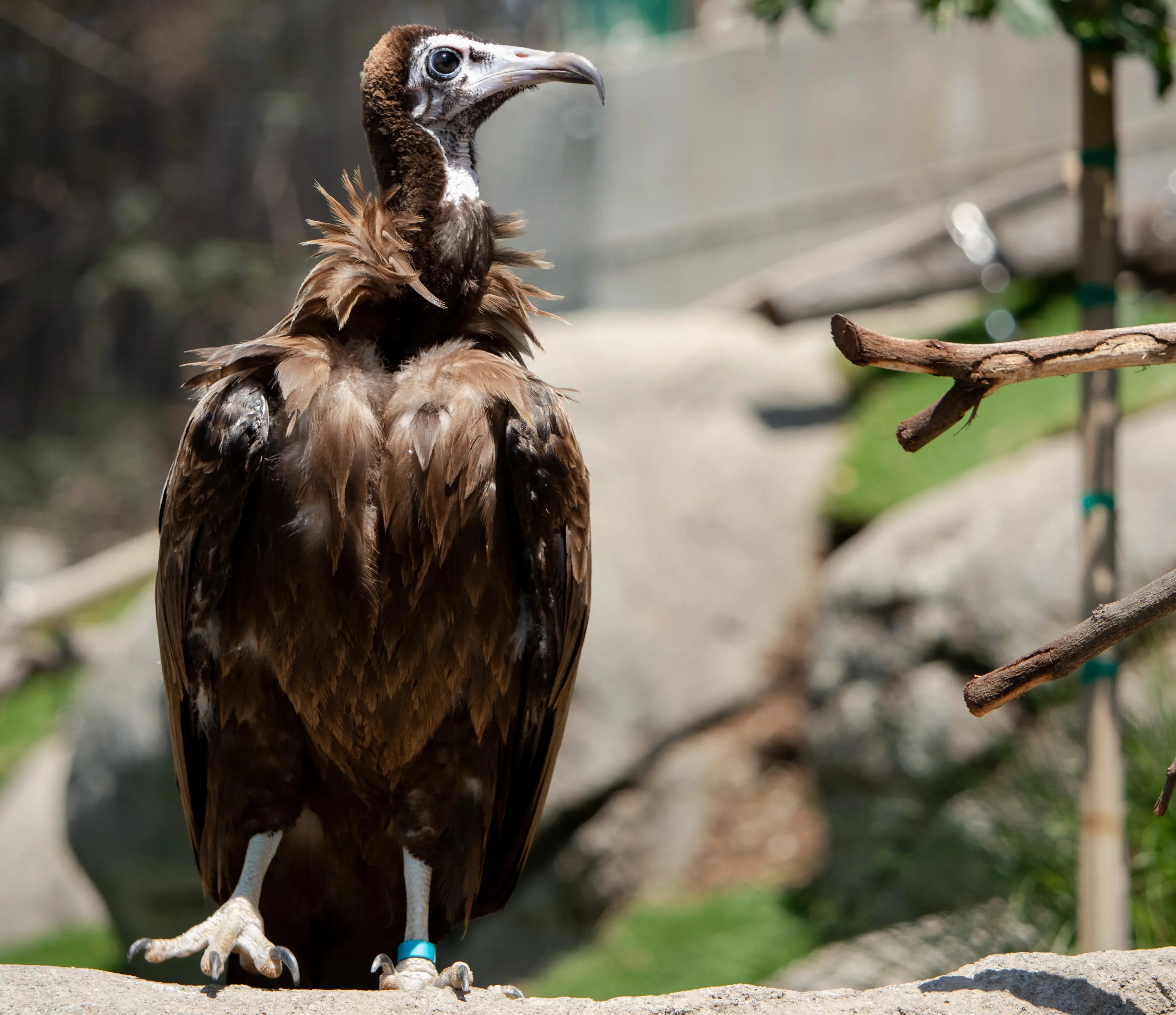
Hooded vultures are small and mostly brown with a white ring of feathers sometimes visible around their neck. Their heads are characteristically naked and pink. They get their name from the “hood” of cream-colored downy feathers that runs along the back of their neck and to the crown of their head. Hooded vultures have a slender, hooked, black beak and a blue eye-ring that is visible in close quarters and sets them apart from other vulture species. Young birds have gray facial skin and brown fluff on the back of the neck. In flight, their rounded tail and silvery flight feathers are visible. Though they only weigh between 3.3 to 5.7 pounds, their wingspan can get up to an impressive 6.5 feet long.
Habitat & Ecology
The hooded vulture is an Old World vulture found only in Africa. This vulture is distributed widely throughout sub-Saharan Africa from Senegal and Mauritania to Sudan, Ethiopia and Somalia. Their range then extends south (away from densely forested areas and continuous desert) all the way down to South Africa.
Hooded vultures occupy a wide variety of habitats, and their familiarity with humans makes them a large presence in urban centers and near agriculture. Their more typical habitat includes open grassland, forest edge, wooded savanna, deserts and along coasts. They require trees high enough to nest, preferably 15 meters or higher, and sufficient carrion to support their population. They can be found as high as 4,000 meters above sea level; however, Hooded Vultures are most abundant below 1,800 meters.
Diet
Hooded vultures are highly opportunistic scavengers. They feed on carrion, bird eggs, trash, excreta, and insects. Along coastlines, hooded vultures will feed on mussels, mollusks, and any dead fish available to them. Vultures in general are highly adapted to digesting the decaying carrion they consume. The heads of vultures contain a diverse microbiome that can outcompete other harmful bacteria that may be present in a carcass. Their digestive tract has an extremely low pH, around 1 or 2, that kills off harmful bacteria entering the body.
Hooded vultures are typically the first vulture species to arrive at kills made by carnivores in rural areas of southern Africa. Since Hooded Vultures are smaller than most others, they can be pushed away from the feeding site by mammals or larger vultures like the White-backed and Lappet-faced, so the ability to arrive first is vital for their feeding. When arriving at carrion, Hooded vultures will begin feeding by grabbing small portions with their beak and then running off to swallow it away from others. Hooded vultures also tend to stay the longest at carcasses as well, even after there is no meat left. They then proceed to pick away at the bones and skin available.
Behavior & Reproduction
Taking advantage of their relative light weight, Hooded vultures are the first vultures to start soaring in the morning because they do not need the strong thermals that come out later in the day in order to fly. This makes it so that they are usually the first vultures to arrive at a carcass. At night, Hooded vultures return to their nest until morning.
Hooded vultures are not particularly social and are typically seen soaring in monogamous pairs or alone. These monogamous pairs will roost together throughout the year. In all areas other than West Africa where they breed year-round, hooded vultures will breed in the rainy season. This timing ensures that there will be plenty of food for the growing chick as the rains return vegetation and herbivores to the area.
At the beginning of the breeding season, hooded vultures pairs will build small stick nests lined with vegetation just below the canopy of tall trees. These nests are usually deep within foliage, unlike other vulture species. Nests are then re-used year after year. Courtship displays are fairly basic, and generally involve the male swooping down on the female. Sometimes however, males will do a slight dance by moving in light circles with their claws held out.
Each year the female lays a single egg and incubates it for about 46 days. Females typically spend most of their time sitting on the egg while the male brings back food. Upon hatching, the chick requires constant attention, and it is totally reliant upon its parents for food. The chick will stay reliant on its parents for food for about 6 months. After around 120 days, the fledged vulture will be about the same size as its parents and will soon complete its first flight.
15-30 years
Rainy Season
1
1 year
Conservation
The hooded vulture is currently classified as Critically Endangered by IUCN, with only 131,000 mature wild individuals and rapidly declining.
In 2000, this species was classified as Least Concern, the lowest category on the red list. Just twelve years later, hooded vultures jumped up the list to the highest category, Critically Endangered.
Hooded vultures have a tendency to hang around human settlements. This has unfortunately made them an easy target for poachers. Hooded vultures are not alone in this. Throughout all of Africa, 7 out of the 10 native vulture species are listed as Endangered or Critically Endangered.
The main threat is a pesticide called Carbofuran or Furadan. This pesticide is being intentionally misused to poison predators like lions or hyenas that could affect livestock. Unfortunately, they are having a much more serious effect on scavengers that tend to congregate in large groups to eat a carcass. Poachers will also use pesticides to hide their kills and intentionally poison vultures so that they cannot circle and alert authorities of their kills. In 2018, over 100 dead vultures were found at the site of a single elephant carcass in Mozambique.
More threats include capture for traditional medicine and bushmeat. In Nigeria, a survey of medicinal traders found that Hooded vulture was the most commonly traded species of vulture, with 90% of all vulture parts traded belonging to the species.
The dramatic loss in vulture populations is a great concern, the effects of which we have already witnessed in Southeast Asia. In the 1990s, vulture populations in India, Pakistan, and Nepal plummeted. This was largely due to a pain reliever called diclofenac that was being used on cattle. Diclofenac turned out to be incredibly toxic to the vultures that fed on livestock carcasses. In only a decade, vulture populations in India dropped as much as 99.9%. This loss in vultures has been directly linked with an increase in human mortality due to diseases such as rabies. Over 100,000 deaths per year have been attributed to the Indian Vulture Crisis. There are now rising concerns as history appears to be repeating itself in Africa.
Fascinating Facts
- Vultures often spread their wings out in what is called a “horaltic pose”.
- Many people mistakenly believe that vultures are dirty animals because of their steady diet of dead animals. However, the exact opposite is true. Vultures enjoy bathing and can spend quite a bit of time around watering holes. And speaking of bathing, vultures also spend time sunbathing, or sunning. But it isn't because they want to get a tan! Among other reasons, it is to help keep their feathers healthy and clean.
- Hooded vultures can be easily recognized by the startlingly blue iris around their eye’s pupil!
About Our Animals
Oakland Zoo’s hooded vultures are Iniko and Oliver. Both have been with us since 2021. Iniko is a female and was hatched in 2020 at Dallas Zoo in Texas. Oliver is a male and was hatched in 2010 at Safari West in Santa Rosa. Both Iniko and Oliver are inseparable and can usually be seen sitting together and sharing food. Though Iniko is still a bit young to breed, we have noticed some nesting behavior from Oliver!
Our Role
Oakland Zoo is part of the breeding effort to stabilize hooded vulture populations. Our resident hooded vultures are a monogamous pair that we hope will eventually produce offspring.