Taveta Golden Weaver
Least Concern
Wetlands and forest
East Africa
Diurnal
Omnivorous
African Savanna
Characteristics
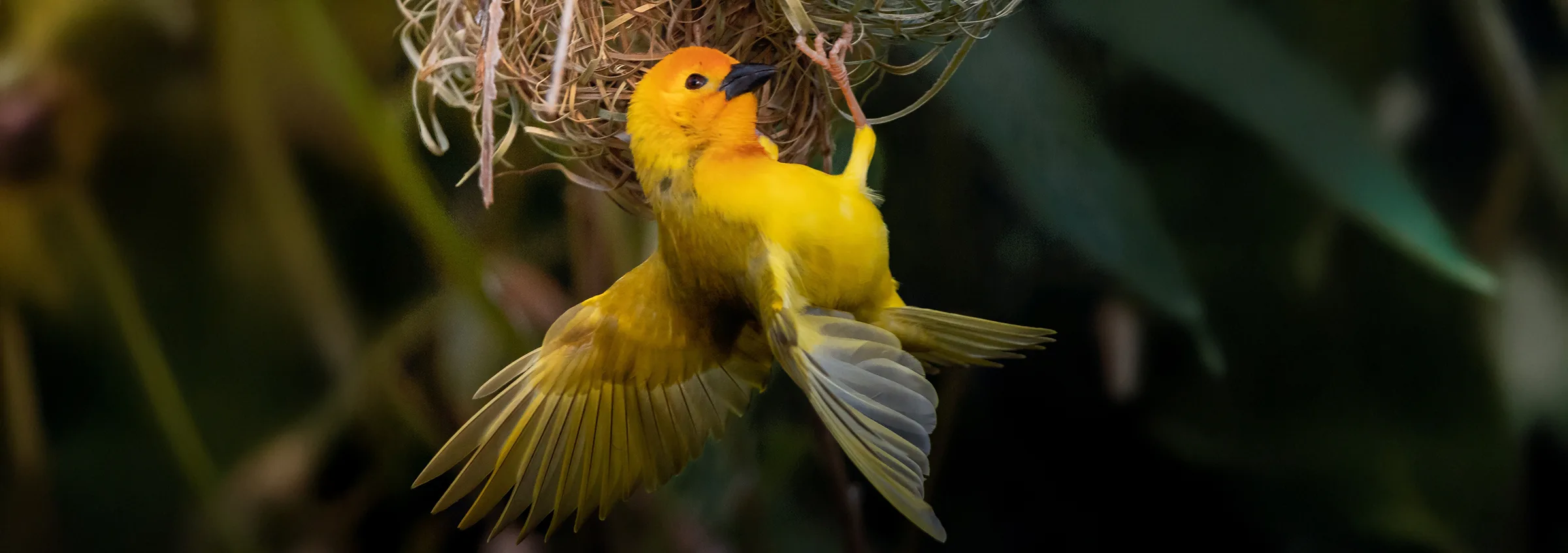
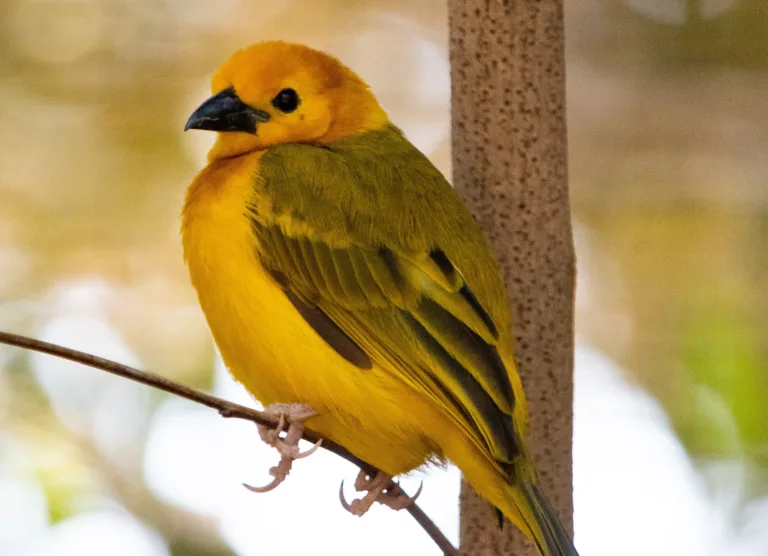
Taveta Golden Weavers are sexually dimorphic, meaning males and females have distinct differences that help to tell them apart. Males are a bright yellow with a greenish-yellow back, greenish wings and tail, and chestnut patches on the nape and chest. Females are a duller yellowish-olive with dusky streaks along the back, a yellowish strip above the eye, and a pale yellow underside. Both males and females have a similar build, growing to about 5.5 inches tall and 0.6-0.8 ounces in weight. They have short, thick bills and strong legs, feet, and claws to hang onto their intricate nests.
Habitat & Ecology
Taveta Golden Weavers have a very small range between southeastern Kenya and northeastern Tanzania. Despite this small range, they are very common within their distribution. They inhabit woodland, forests, swamps, and other riparian areas. They generally nest in marshes and swamps, but they also rely on drier adjacent habitat during the non-breeding season.
Diet
These birds are primarily seed-eaters, but feed on grasses as well. As seed eaters, these birds have especially short and thick bills that are perfect for cracking the outer hulls open. Additionally, during the breeding and nesting season they will hunt live insects in order to build up more energy.
Behavior & Reproduction
Taveta Golden Weavers live in groups and nest in large colonies. Colonial living is a fantastic adaptation for predator avoidance. With many sets of eyes always keeping watch, the first bird to spot a predator can alert the others so that as many individuals as possible can escape and survive.
Taveta Golden Weavers are assumed to be polygynous. During the breeding season, males use their strong claws and bill to weave elaborate and tightly woven nests from long strands of grass. Weavers are named after the nests they build. It is not uncommon for multiple mated pairs to build a single large, elaborate nest with many apartment-like chambers. Females will choose a male to mate with based on the nest he has built, and will line the inside of the nest with grass or other soft material before laying 2-3 olive green eggs. The female incubates the egg for 13 days. After the nestlings hatch, they are fed insects and other live food by their mother before fledging at approximately 14 days old.
Wild: 10 years, Protected Care: 20 years
September-May
2-3
1 year
Conservation
Taveta Golden Weavers are considered to be of Least Concern on the IUCN Red List. Their population trend remains stable despite their limited natural range.
Fascinating Facts
- Taveta Golden Weavers are considered “true” weavers based on their behavior of weaving nests from thin strips of plant material.
- Their songs and calls are often described as “harsh” and “tuneless” to the human ear.