Siamang
Endangered
Forest
Southeast Asia
Diurnal
Omnivorous
Tropical Rainforest
Characteristics
Siamangs belong to a family of lesser apes called gibbons. Like other apes, they lack a tail and have opposable thumbs on their hands and feet. Their opposable toe is called a greater toe, which allows them to walk and balance along tree branches in the upper canopies. Siamangs are the largest of the gibbon species, weighing around 25 lbs. They stand between 2.5-3 feet tall with an arm span that can reach 2.5 times that of their height.
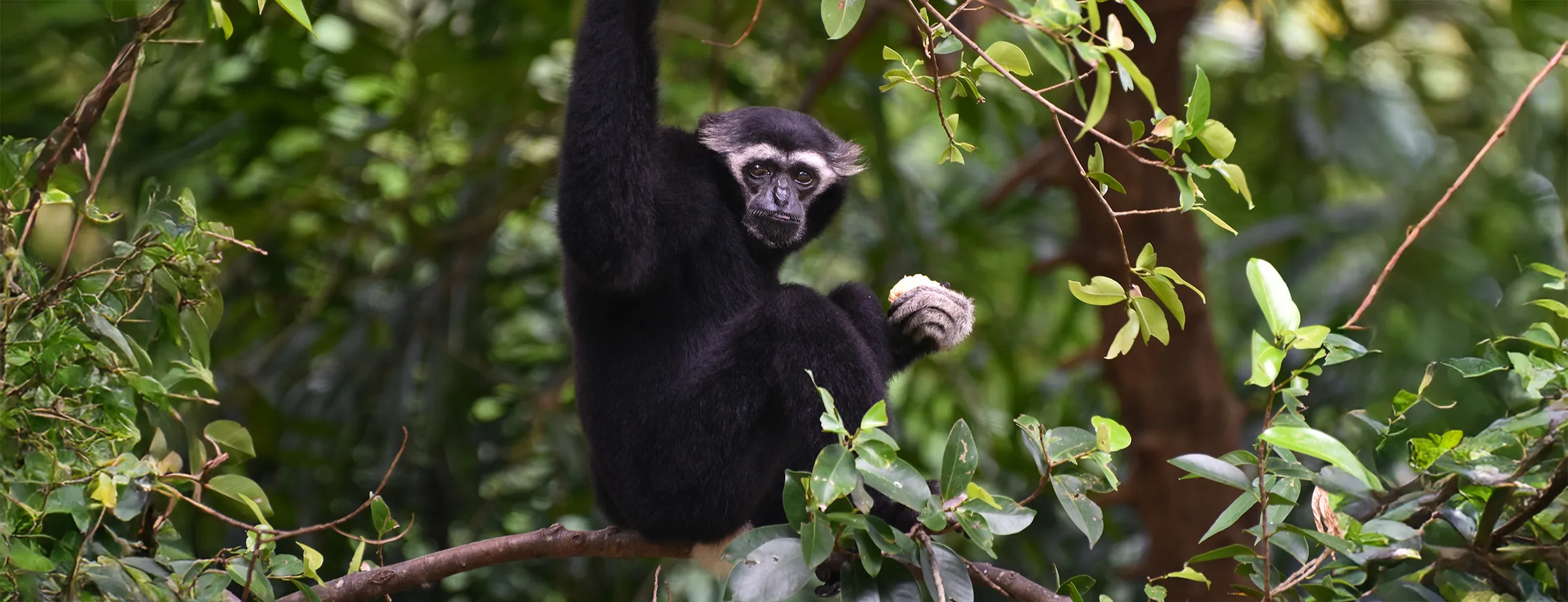
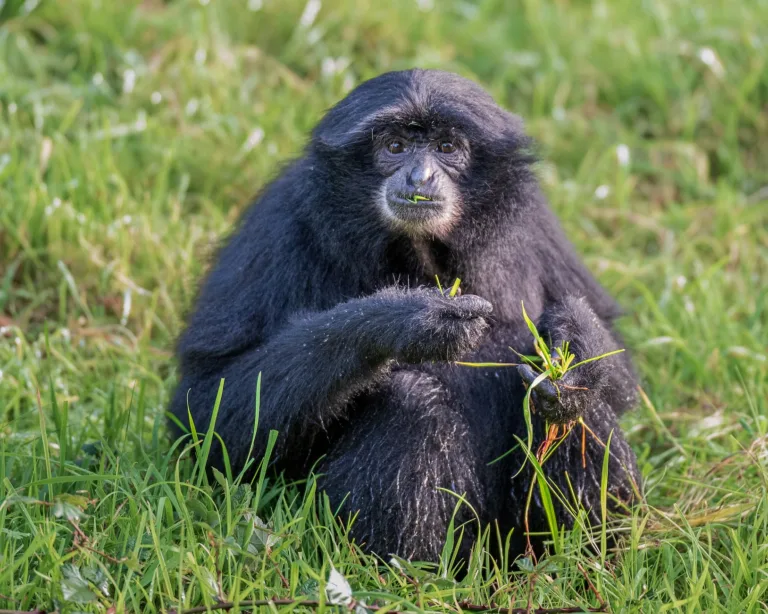
Siamangs have a thick black coat, with a shallow, hairless face. They are well known for their enlarged throat sac called a gular sac. The gular sac can inflate to be as large as a human head, and allows them to create a loud call that can be heard from miles away.
Habitat & Ecology
Siamangs are found in the mountainous regions of Southeast Asia. In particular, they live in the Barisan Mountains of Sumatra and the mountains of the Malay Peninsula. They inhabit rainforests and monsoon forests and stick to the mid-upper canopies.
Diet
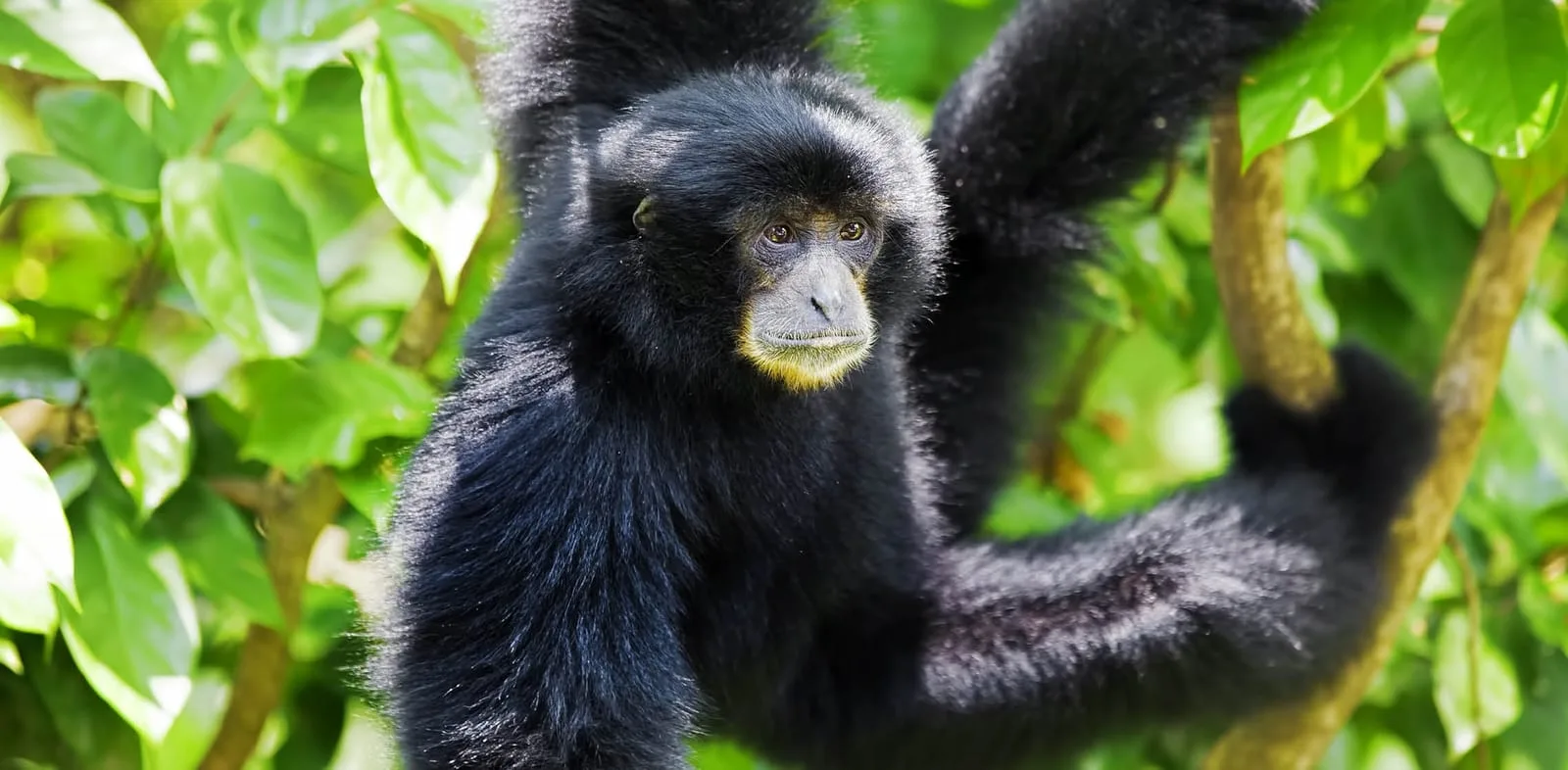
Siamangs are considered omnivores, but mostly eat fruits, leaves, and berries. Figs are a favorite fruit of the siamangs, likely due to their abundance in Sumatra and Malaysia. On occasion, they will also eat small animals such as birds and small rodents, and opportunistically eggs and insects as well. Siamangs consume more leaves than any other gibbon species, and leaves can constitute just under 50% of their diet. It can take a siamang up to 5 hours a day to eat their fill.
Behavior & Reproduction
Siamang are diurnal and stick to a fairly strict daily routine. Siamangs mate for life, and every morning in the early hours when they wake up, siamang pairs will perform their “songs”. These songs are calls they compose with each other during courtship. When lost, they can use the songs to communicate and find each other again. No two pairs sing the same songs. The rest of the day for a siamang consists of eating, grooming, and brachiating, a specialized way of swinging from tree branch to tree branch, before settling down in their resting spots to sleep. Because of their rigid lifestyle, they can become upset when anything in their routine changes. Siamangs will chase off any intruders to their territory by bellowing or screaming while running at them with their arms in the air.
Siamangs reach maturity at the age of 6 or 7, at which point they depart their family unity to find a partner. Once a pair has bonded and mated, they stay together for life. If one dies, the widowed gibbon does not take up a new mate and usually dies shortly after. Females give birth to a single offspring every 2-3 years. Their pregnancy lasts 7 months and mothers will continue to nurse their baby for the first 2 years of their lives. Males assist in caring for their young until they are around 3 years old, at which point the juvenile becomes more independent and starts wandering further away from their parents. Their basic family unit usually consists of a mated adult pair and 2 or 3 of their children who have not yet reached maturity. Each child is 2 to 3 years apart from each other.
Wild: 20-40 years, Protected Care: 40+ years
Year-round
1
2-3 years
Conservation
Siamangs are currently listed as Endangered on the IUCN Red List. In the latest assessment, done in 2020, their population trend was found to be decreasing. One of their biggest threats is increased habitat loss and destruction largely due to residential, commercial, and agricultural development. They are also sometimes taken from the wild for the illegal pet trade.
Fascinating Facts
- Siamangs get part of their scientific name from their toes. The word syndactylus means having toes that are connected by a small layer of flesh. Siamang’s 2nd and 3rd toes are connected by a small layer of flesh.
- The siamang’s throat sac can inflate to be as large as a human head.
- Siamang calls can be heard up to 2 miles away!
- Gibbons are not monkeys! They are the only apes not considered “great apes” and are instead classified as “lesser apes”.
About Our Animals
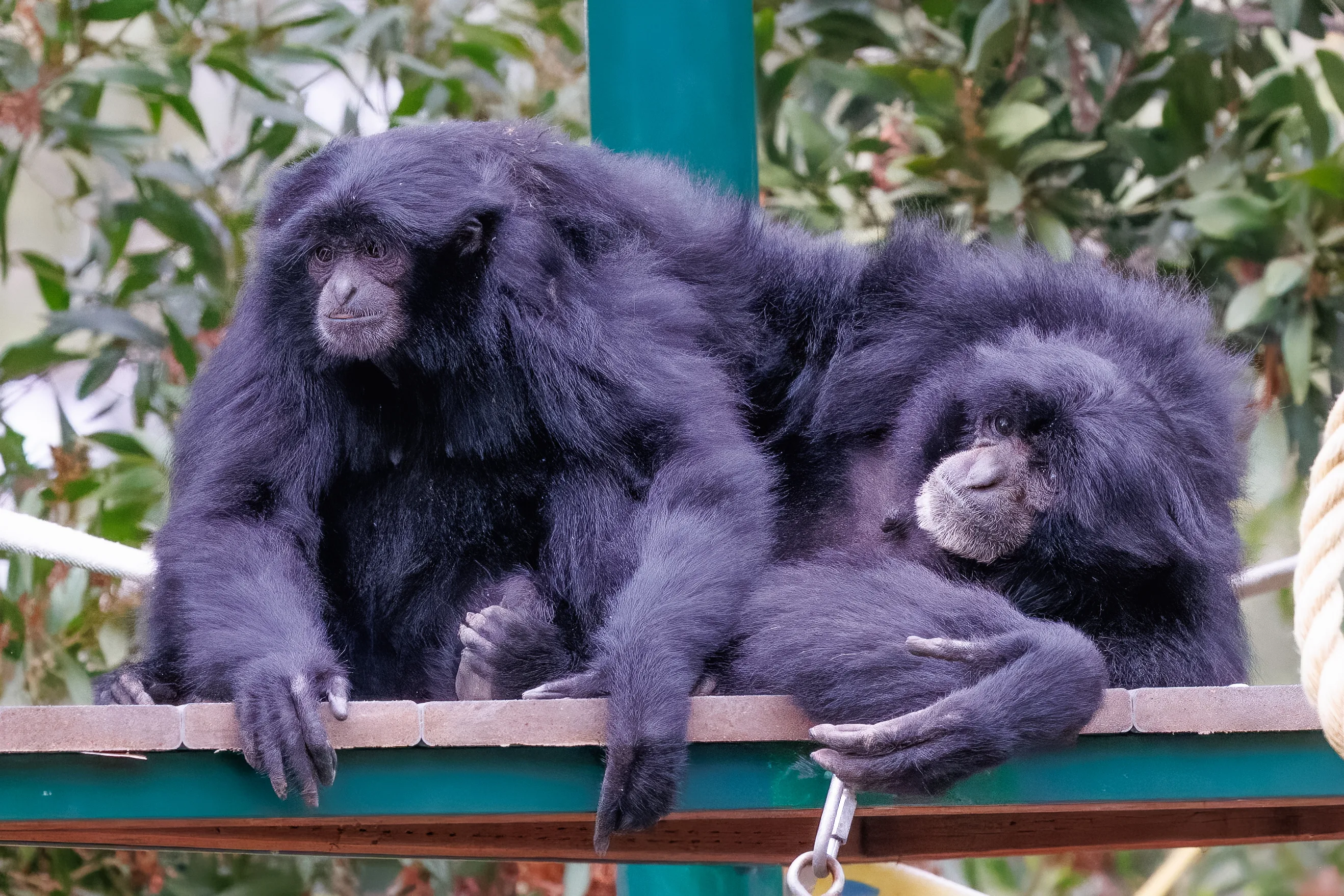
Siamang island is inhabited by two siamangs, Sid and Raya.
In May 2025, male siamang Hahnumahn passed away, leaving Sid, the Zoo's 9-year-old female siamang, alone in her habitat. The Zoo eagerly collaborated with the Association of Zoos and Aquariums (AZA) and the siamang Species Survival Plan (SSP) to find a new companion for Sid. The SSP recommended Raya (pronounced Rye-uh), a 2-year-old female who had been waiting for her forever home. Raya, sadly, lost her parents at a young age, and AZA has been seeking a new home for her ever since. Sid, meanwhile, had never had children of her own. Although their histories make this pairing unusual, Oakland Zoo and AZA/SSP were hopeful about their future together.
The two females are getting along great and have become sweet companions to each other!
Our Role
Oakland Zoo has projects to help end the exotic pet trade and to curb palm oil production, both of which affect siamang in the wild. Here are some ways you can help too:
- Look for sustainable products, especially those that come from the rainforest, like coffee and chocolate. Look into shade grown varieties and companies that use sustainable palm oil or none at all.
- You can help stop the illegal pet trade by getting responsibly bred animals as pets and educating those around you about the plight of wild-caught exotic pets.